Home /
Expert Answers /
Advanced Math /
advanced-ordinary-differential-equations-project-10-the-proof-of-the-frobenius-theorem-and-bes-pa925
(Solved): Advanced ordinary differential equations Project 10: The proof of the Frobenius Theorem and Bes ...
Advanced ordinary differential equations
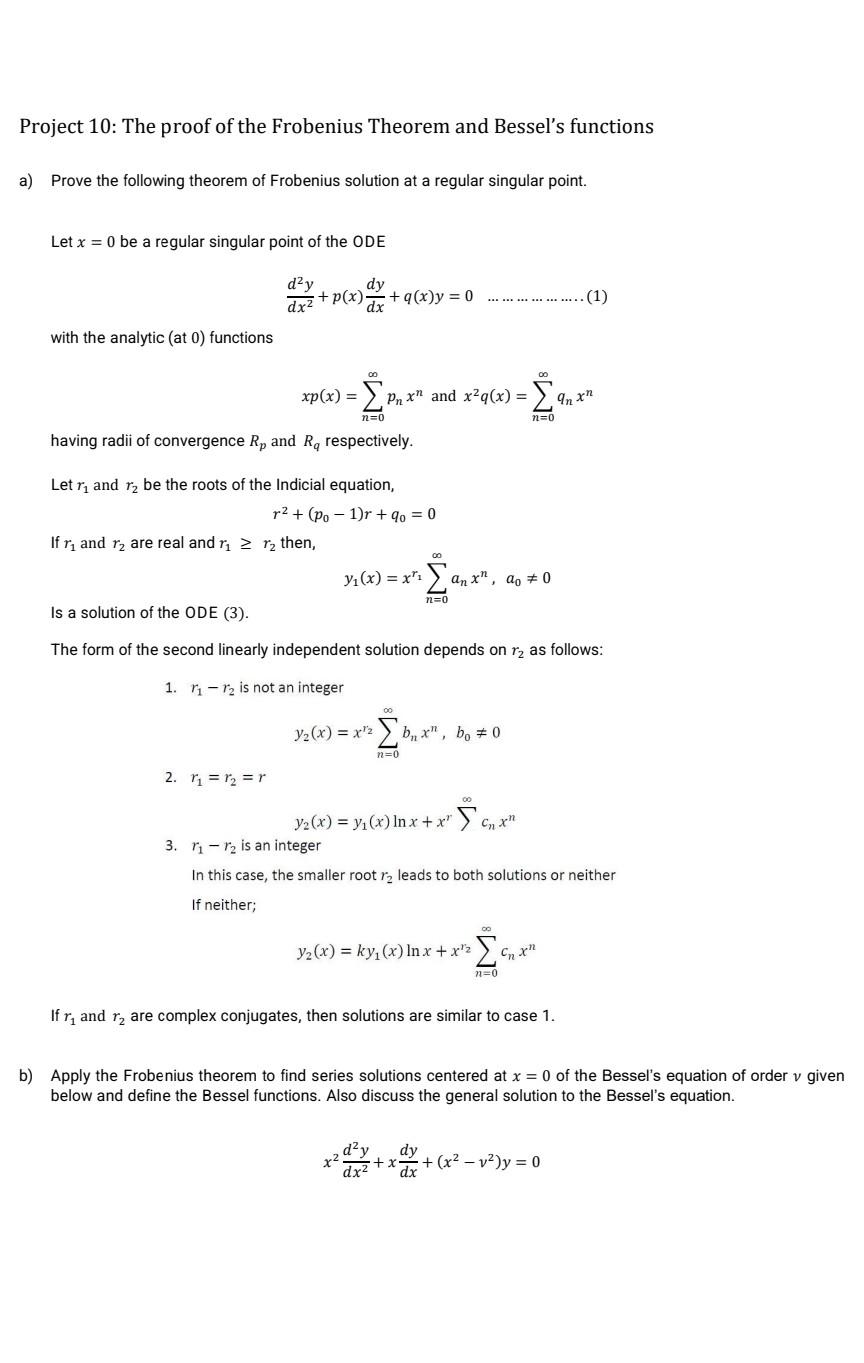
Project 10: The proof of the Frobenius Theorem and Bessel's functions a) Prove the following theorem of Frobenius solution at a regular singular point. Let be a regular singular point of the ODE with the analytic (at 0 ) functions having radii of convergence and respectively. Let and be the roots of the Indicial equation, If and are real and then, Is a solution of the ODE (3). The form of the second linearly independent solution depends on as follows: 1. is not an integer 2. 3. is an integer In this case, the smaller root leads to both solutions or neither If neither; If and are complex conjugates, then solutions are similar to case 1 . b) Apply the Frobenius theorem to find series solutions centered at of the Bessel's equation of order given below and define the Bessel functions. Also discuss the general solution to the Bessel's equation.