(Solved): Voltage-gated channels and action potentials - To explain the basics of action potentials, you only ...
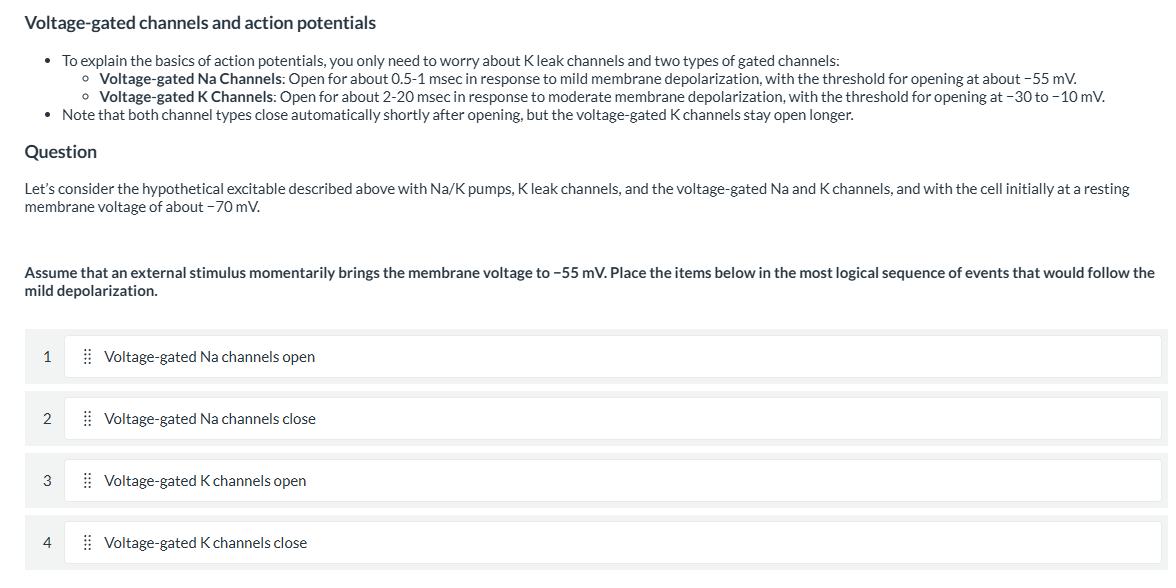
Voltage-gated channels and action potentials - To explain the basics of action potentials, you only need to worry about K leak channels and two types of gated channels: - Voltage-gated Na Channels: Open for about \( 0.5-1 \mathrm{msec} \) in response to mild membrane depolarization, with the threshold for opening at about -55 mV . - Voltage-gated K Channels: Open for about 2-20 msec in response to moderate membrane depolarization, with the threshold for opening at -30 to -10 mV . - Note that both channel types close automatically shortly after opening, but the voltage-gated K channels stay open longer. Question Let's consider the hypothetical excitable described above with \( \mathrm{Na} / \mathrm{K} \) pumps, K leak channels, and the voltage-gated Na and K channels, and with the cell initially at a resting membrane voltage of about -70 mV . Assume that an external stimulus momentarily brings the membrane voltage to -55 mV . Place the items below in the most logical sequence of events that would follow the mild depolarization. \( 1 \quad \) \# Voltage-gated Na channels open \( 2 \quad \) : Voltage-gated Na channels close \( 3 \quad \vdots \) Voltage-gated \( K \) channels open \( 4 \quad \) \# Voltage-gated K channels close