Home /
Expert Answers /
Other /
1-based-on-this-case-what-are-the-marketing-dimensionsthat-singapore-airlines-does-well-how-about-di
(Solved): 1. Based on this case, What are the marketing dimensionsthat Singapore Airlines does well? How about ...
1. Based on this case, What are the marketing dimensionsthat Singapore Airlines does well? How about dimensions they arenot good at?
2. What are the external factors that SIA should look at thatcan affect the growth of their business operations?
3. How can they keep their competitive advantages?
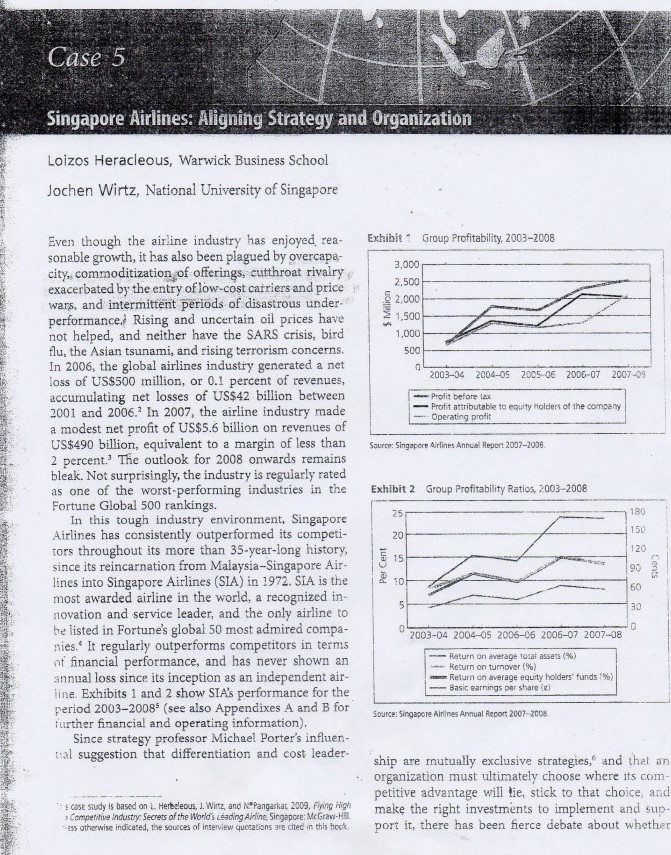
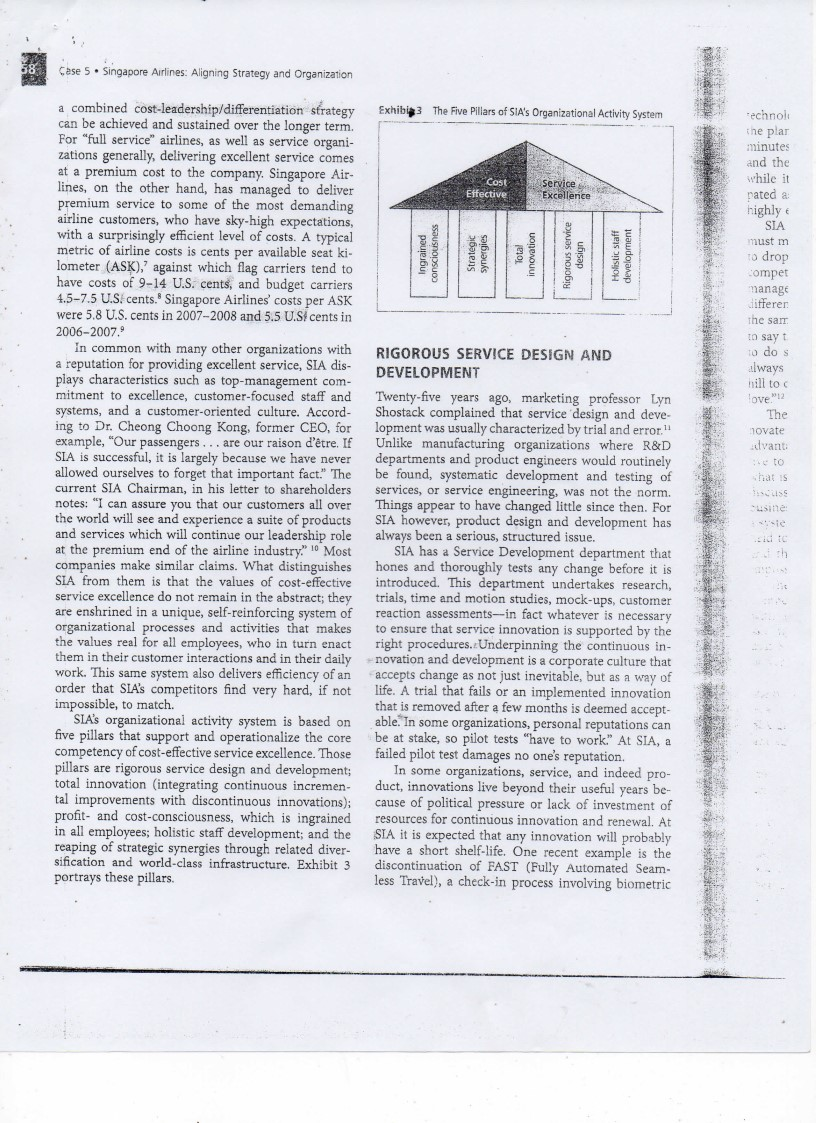
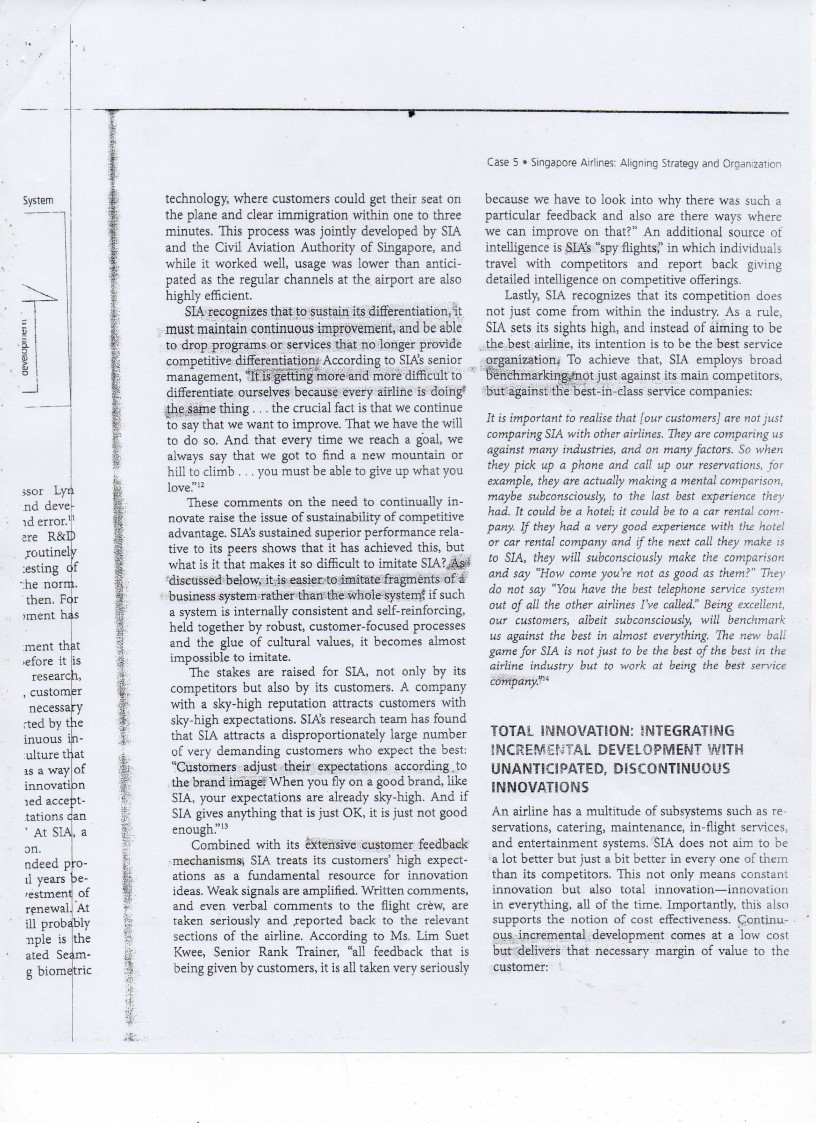
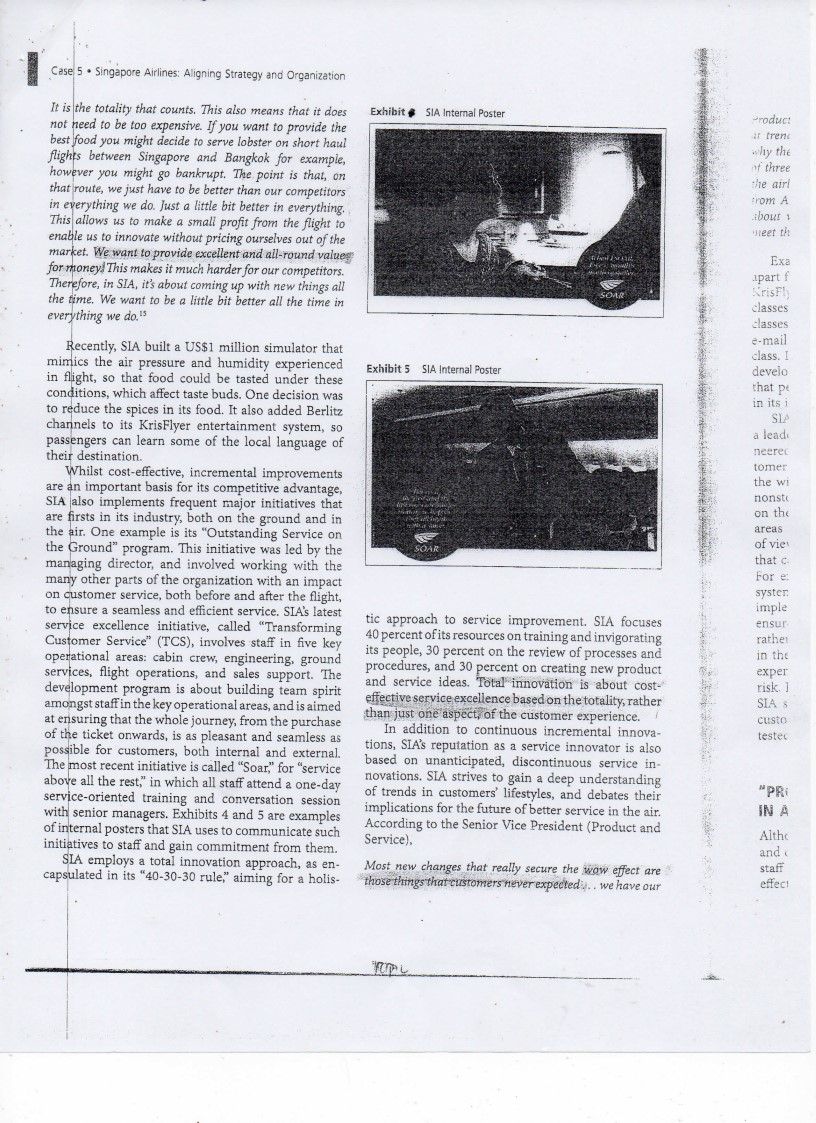
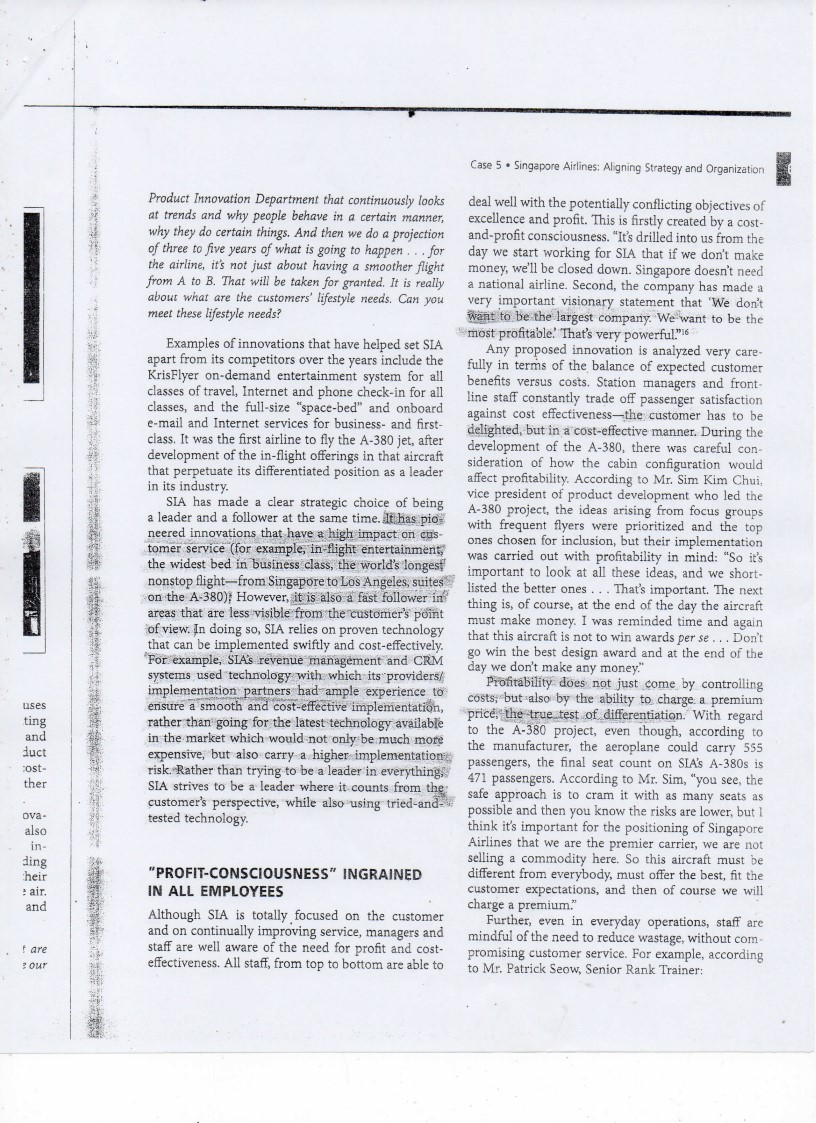
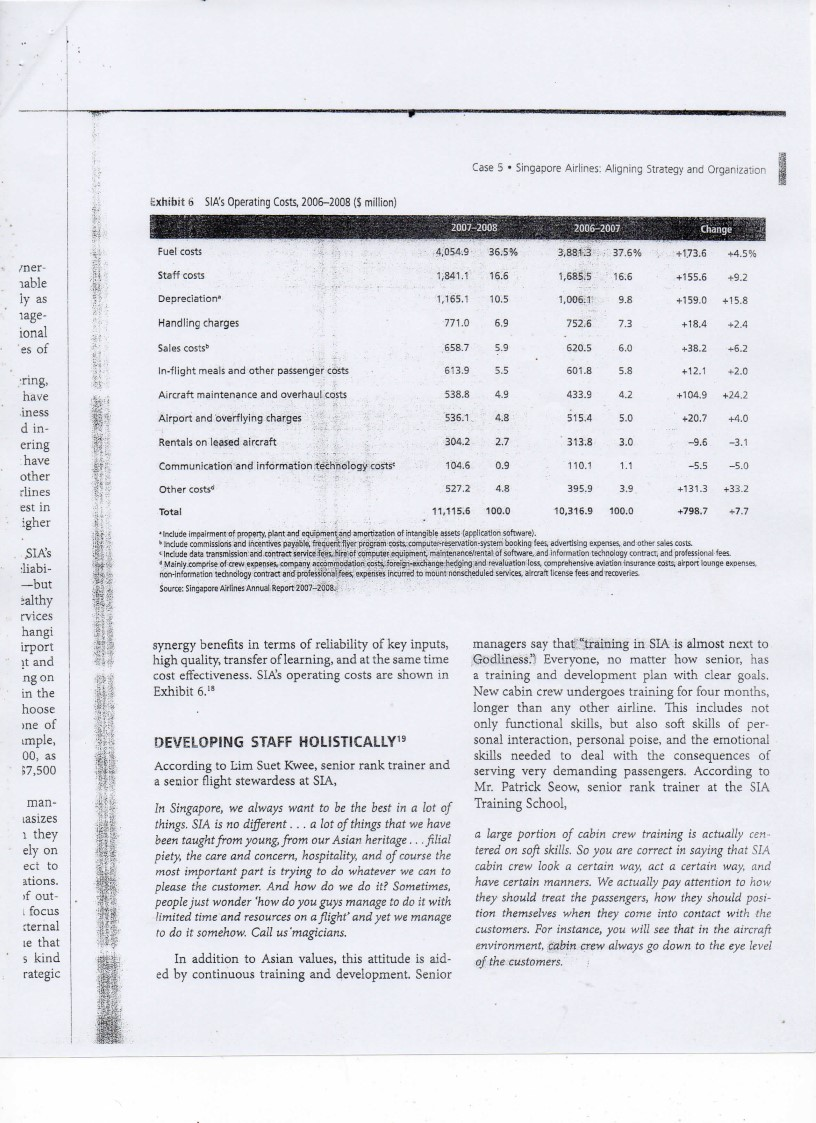
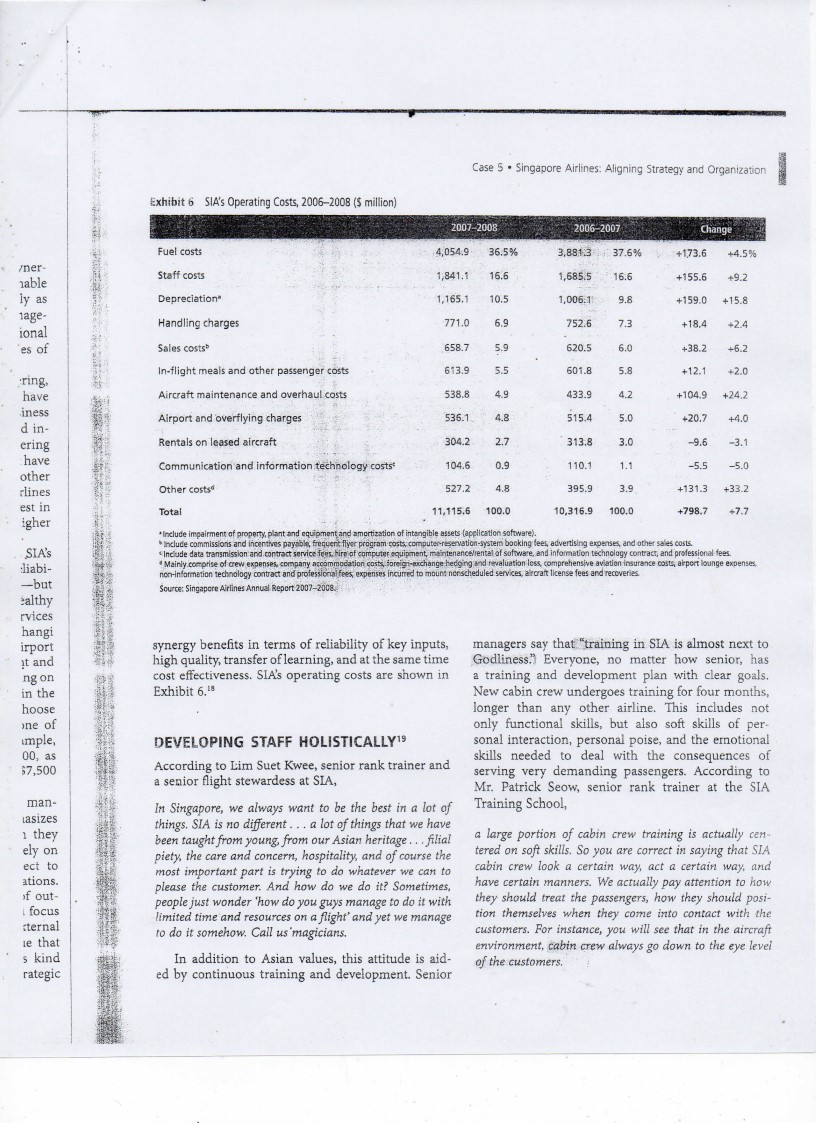
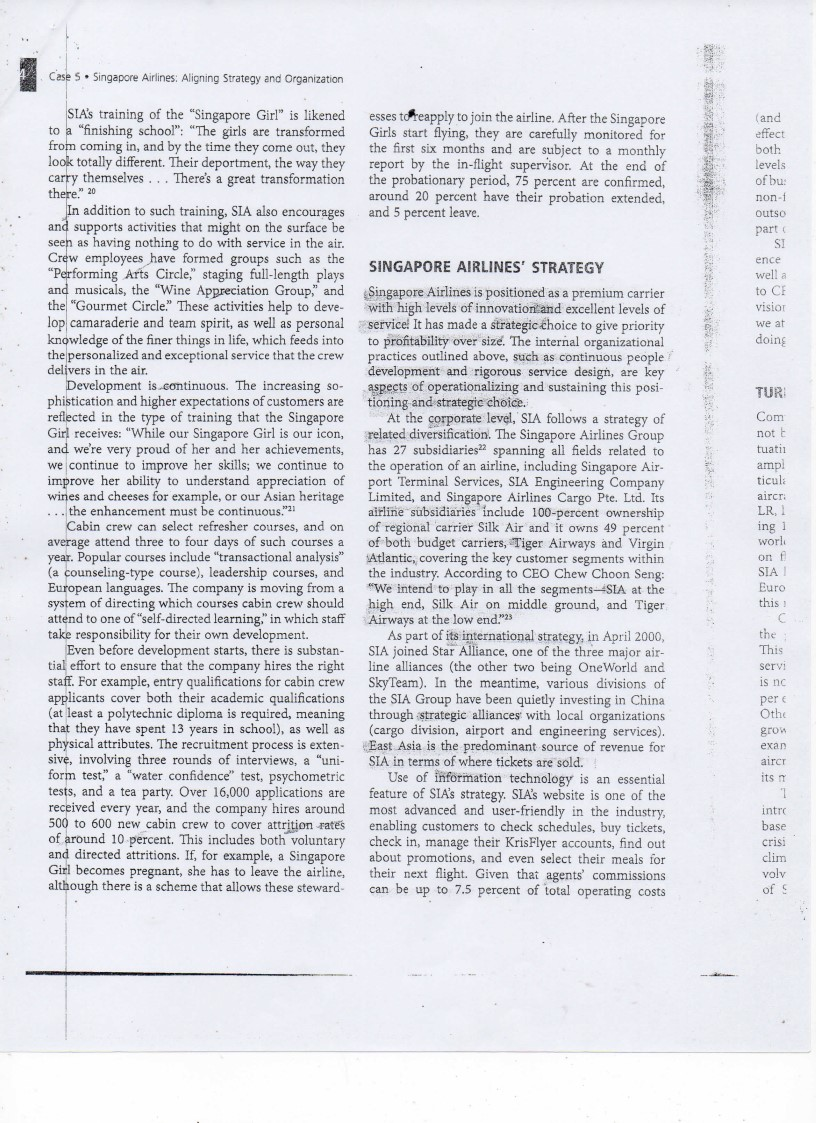
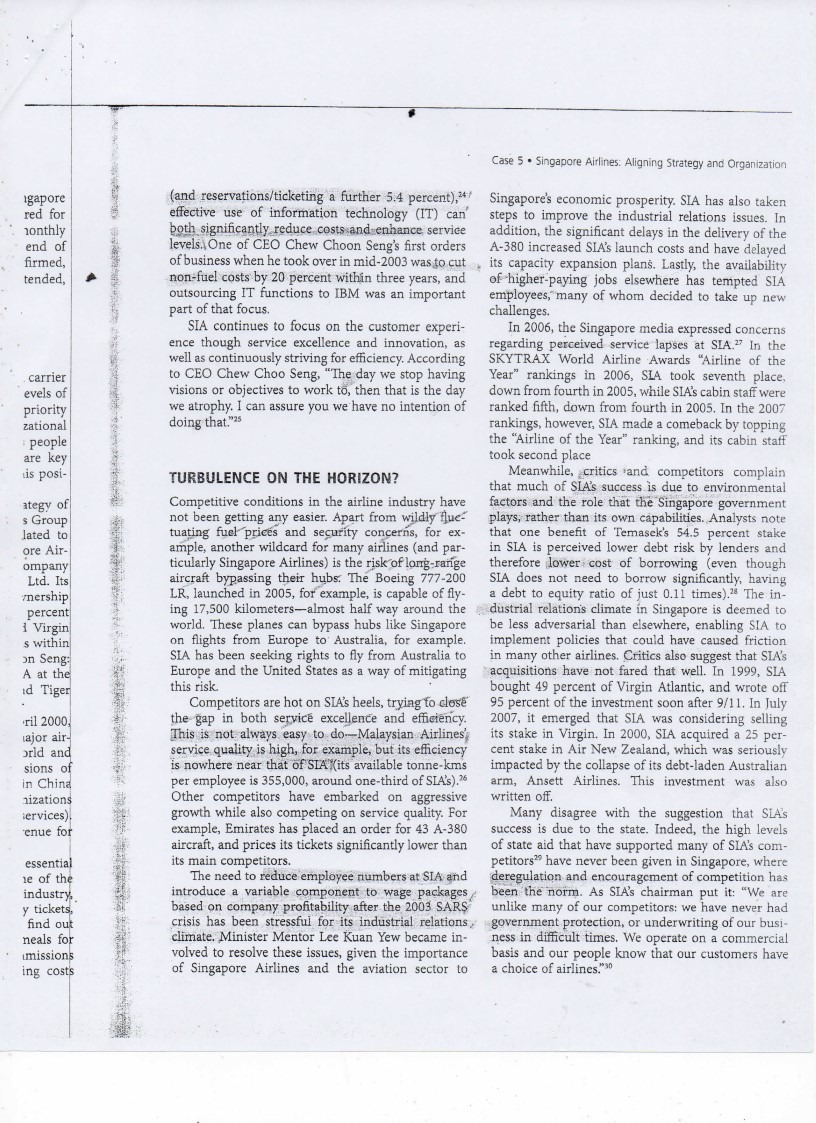
Case 5 Singapore Airlines: Aligning Strategy and Organization Loizos Heracleous, Warwick Business School Jochen Wirtz, National University of Singapore Exhibit? Group Profitability, 2003-2008 $ Million 3,000 2.500 2,000 1,500 1,000 500 0 2003-04 2004-05 2005-06 2006-07 2007-09 Profit before tax Profit attributable to equity holders of the company Operating profit Source: Singapore Airlines Annual Report 2007-2008 Exhibit 2 Group Profitability Ratios, 2003-2008 Even though the airline industry has enjoyed rea- sonable growth, it has also been plagued by overcapa- city, commoditization of offerings, cutthroat rivalry exacerbated by the entry of low-cost carriers and price wars, and intermittent periods of disastrous under performance. Rising and uncertain oil prices have not helped, and neither have the SARS crisis, bird flu, the Asian tsunami, and rising terrorism concerns. In 2006, the global airlines industry generated a net loss of US$500 million, or 0.1 percent of revenues, accumulating net losses of US$42 billion between 2001 and 2006. In 2007, the airline industry made a modest net profit of US$5.6 billion on revenues of US$490 billion, equivalent to a margin of less than 2 percent. The outlook for 2008 onwards remains bleak. Not surprisingly, the industry is regularly rated as one of the worst-performing industries in the Fortune Global 500 rankings. In this tough industry environment, Singapore Airlines has consistently outperformed its competi- tors throughout its more than 35-year-long history, since its reincarnation from Malaysia-Singapore Air- lines into Singapore Airlines (SIA) in 1972. SIA is the most awarded airline in the world, a recognized in novation and service leader, and the only airline to be listed in Fortune's global 50 most admired compa- nies. It regularly outperforms competitors in terms of financial performance, and has never shown an annual loss since its inception as an independent air- line Exhibits 1 and 2 show SIA's performance for the period 2003-20085 (see also Appendixes A and B for Further financial and operating information). Since strategy professor Michael Porter's influen- tal suggestion that differentiation and cost leader- 25 180 150 20 120 Per Cent 90 Cents 10 60 5 30 0 0 2003-04 2004-05 2006-06 2006-07 2007-08 Return on average total assets (%) Return on turnover (%) Return on average equity holders' funds%) Basic earnings per shared Source: Singapore Airlines Annual Report 2007-2008 ship are mutually exclusive strategies, and that an organization must ultimately choose where its com- petitive advantage will tie, stick to that choice, and make the right investments to implement and sup- port it, there has been fierce debate about whether s case study is based on L. Herbeleous, I. Wirtz, and Pangarkat 2009, fining High Competitive industry: Secrets of the World's Leading Airline Singapore: McGraw-HR - 25 otherwise indicated, the sources of interview quotations are cited in this book 58 Case 5. Singapore Airlines: Aligning Strategy and Organization Exhibit3 The Five Pillars of SIA's Organizational Activity System -echnol the plar minutes and the Cost Effective Service Excellence while it nated a highly SIA SIA must m to drop compet manage Hifferer teren the sarr to sayt to do s always will to love "2 The nova dvant a combined cost-leadership/differentiation strategy can be achieved and sustained over the longer term. For "full service airlines, as well as service organi- zations generally, delivering excellent service comes at a premium cost to the company. Singapore Air- lines, on the other hand, has managed to deliver premium service to some of the most demanding customers, who have sky-high expectations, with a surprisingly efficient level of costs. A metric of airline costs is cents per available seat ki- typical lometer (ASK), against which flag carriers tend to costs of 9-14 U.S. cents, and budget carriers 4.5-7.5 U.S. cents." Singapore Airlines' costs per ASK were 5.8 U.S.cents in 2007-2008 and 5.5 U.Stcents in 2006-2007 In common with many other organizations with reputation for providing excellent service, SIA dis- plays characteristics such as top-management com- mitment to excellence, customer-focused staff and systems, and a customer-oriented culture. Accord- ing to to Dr. Cheong Choong Kong, former CEO, for example, "Our passengers . . . are our raison d'être. If SIA is successful, it is largely because we have never allowed ourselves to forget that important fact." The current SIA Chairman, in his letter to shareholders notes: "I can assure you that our customers all over the world will see and experience a suite of products and services which will continue our leadership role at the premium end of the airline industry. 10° Most companies make similar claims. What distinguishes SIA from them is that the values of cost-effective service excellence do not remain in the abstract; they are enshrined in a unique, self-reinforcing system of organizational processes and activities that makes the values real for all employees, who in turn enact them in their customer interactions and in their daily work. This same system also delivers efficiency of an order that SIA's competitors find very hard, if not impossible, to match. five pillars that support and operationalize the core SIA's organizational activity system is based on competency of cost-effective service excellence. Those pillars are rigorous service design and development; total innovation (integrating continuous incremen- tal improvements with discontinuous innovations): profit- and cost-consciousness, which is ingrained in all employees; holistic staff development; and the reaping of strategic synergies through related diver- sification and world-class infrastructure. Exhibit 3 portrays these pillars. shat 15 suss ousine RIGOROUS SERVICE DESIGN AND DEVELOPMENT Twenty-five years ago, marketing professor Lyn Shostack complained that service design and deve- lopment was usually characterized by trial and error. 11 Unlike manufacturing organizations where R&D departments and product engineers would routinely be found, systematic development and testing of services, or service engineering, was not the norm. Things appear to have changed little since then. For SIA however, product design and development has always been a serious, structured issue. SIA has a Service Development department that hones and thoroughly tests any change before it is introduced. This department undertakes research, trials, time and motion studies, mock-ups, customer reaction assessments--in fact whatever is necessary to ensure that service innovation is supported by the right procedures. : Underpinning the continuous in- novation and development is a corporate culture that accepts change as not just inevitable, but as a way of life. A trial that fails or an implemented innovation that is removed after a few months is deemed accept- able. In some organizations, personal reputations can be at stake, so pilot tests have to work." At SIA, a failed no one's reputation In some organizations, service, and indeed pro- duet, innovations live beyond their useful years be- cause of political pressure or lack of investment of resources for continuous innovation and renewal. At s expected that any innovation will probably have a short shelf-life. One recent example is the discontinuation of FAST (Fully Automated Seam- less Travel), a check-in process involving biometric A pilot test SIA it is - Case 5 • Singapore Airlines: Aligning Strategy and Organization System efficient A Hadanan to drop love." pany. If they had 3sor Lyn nd deve- ad error. 11 are R&D routinely esting of "he norm. then. For ment has technology, where customers could get their seat on because we have to look into why there was such a the plane and clear immigration within one to three particular feedback and also are there ways where minutes. This process was jointly developed by SIA we can improve on that?" An additional source of and the Civil Aviation Authority of Singapore, and intelligence is SIA's "spy flights" in which individuals while it worked well, usage was lower than antici- travel with competitors and report back giving pated as the regular channels at the airport are also detailed intelligence on on competitive offerings highly Lastly, SIA recognizes that its competition does SIA recognizes that to sustain its differentiation, it not just come from within the industry. As a rule, must maintain continuous improvement, and be able SIA sets its sights high, and instead of aiming to be programs or or services that no longer provide the best airline, its intention is to be the best service competitive differentiations According to SIA's senior organization. To achieve that, SIA employs broad management, "It is getting more and more difficult to benchmarking not just against its main competitors, differentiate ourselves because every airline is doing but against the best-in-class service companies: the same thing the crucial fact is that we continue to say that we want to improve. That we have the will It is important to realise that our customers) are not just to do so. And that every time we reach a goal, we comparing SIA with other airlines. They are comparing us always say that we got to find a new mountain or against many industries, and on many factors. So when hill to climb... you must be able to give up what you they pick up a phone and call up our reservations, for example, they are actually making a mental comparison These comments on the need to continually in maybe subconsciously, to the last best experience they novate raise the issue of sustainability of competitive had. It could be a hotels it could be to a car rental com advantage. SLA's sustained superior performance rela- very good experience with the hotel tive to its peers shows that it has achieved this, but or car rental company and if the next call they make what is it that makes it so difficult to imitate SIA? As to SIA, they will subconsciously make the comparison discussed below, it is easier to imitate fragments and say "How come you're not as good as them?" They business system rather than the whole system if such do not say "You have the best telephone service system a system is internally consistent and self-reinforcing, out of all the other airlines I've called." Being excellent, together by robust, customer-focused processes our customers, albeit subconsciously, will benchmark and the glue of cultural values, it becomes almost us against the best in almost everything. The new ball impossible to imitate. game for SIA is not just to be the best of the best in the The stakes are raised for SIA, not only by its airline industry but to work at being the best service but also by its customers. A competitors company.4 company with a sky-high reputation attracts customers with sky-high expectations. SIA's research team has found that SIA attracts a disproportionately large number TOTAL INNOVATION: INTEGRATING very demanding customers who expect the best: INCREMENTAL DEVELOPMENT WITH "Customers adjust their expectations according to UNANTICIPATED, DISCONTINUOUS the brand image! When you fly on a good brand, like INNOVATIONS SIA, your expectations are already sky-high. And if SIA gives anything that is just OK, it is just not good An airline has a multitude of subsystems such as re servations, catering, maintenance, in-flight services, Combined with its extensive customer feedback and entertainment systems. SIA does not aim to be mechanisms SIA treats its customers' high expect a lot better but just a bit better in every one of them ations as a fundamental resource for innovation than its competitors. This means constant ideas. Weak signals are amplified. Written comments, innovation but also total innovation-innovation and even verbal comments to the flight crew, are in everything, all of the time. Importantly, this also taken seriously and reported back to the relevant supports the notion of cost effectiveness. Continu- sections of the airline. According to Ms. Lim Suet ous incremental development comes at a low cost Kwee, Senior Rank Trainer, "all feedback that is but delivers that necessary margin of value to the being given by customers, it is all taken very seriously customer: held ment that efore it is research, customer necessary ted by the inuous in- ulture that as a way of innovation ned accept- tations dan At SIA, a on ndeed pro- il years be- restment of renewal. At ill probably mple is the ated Seam- g biometric enough." Case 5 Singapore Airlines: Aligning Strategy and Organization Exhibit & SIA Internal Poster Product at trend why the of three the airl from A About Wieet the MER ws SOAR Exhibit 5 SIA Internal Poster It is the totality that counts. This also means that it does not need to be too expensive. If you want to provide the best food you might decide to serve lobster on short haul flights between Singapore and Bangkok for example, however you might go bankrupt. The point is that, on that route, we just have to be better than our competitors n everything we do. Just a little bit better in This allows us to make a small profit from the flight to enable us to innovate without pricing ourselves out of the market. We want to provide excellent and all-round valueg for money. This makes it much harder for our competitors. Therefore, in SIA, it's about coming up with new things all the time. We want to be a little bit better all the time in everything we dots Recently, SIA built a US$1 million simulator that mimics the air pressure and humidity experienced in flight, so that food could be tasted under these conditions, which affect taste buds. One decision was to reduce the spices in its food. It also added Berlitz channels to its KrisFlyer entertainment system, so passengers can learn some of the local language of their destination Whilst cost-effective, incremental improvements are an important basis for its competitive advantage, SIA also implements frequent major initiatives that are firsts in its industry, both on the ground and in the air. One example is its "Outstanding Service on the Ground" program. This initiative was led by the managing director, and involved working with the many other parts of the organization with an impact on customer service, both before and after the flight, to ensure a seamless and efficient service. SIA'S latest service excellence initiative, called "Transforming Customer Service" (TCS), involves staff in five key operational areas: cabin crew, engineering, ground services, flight operations, and sales support. The development program is about building amongst staff in the key operational areas, and is aimed at ensuring that the whole journey, from the purchase of the ticket onwards, is as pleasant and seamless as possible for customers, both internal and external. The most recent initiative is called "Soar" for "service above all the rest." in which all staff attend a one-day service-oriented training and conversation session with senior managers. Exhibits 4 and 5 are examples of internal posters that SIA uses to communicate such initiatives to staff and gain commitment from them. SIA employs a total innovation approach, as en- capsulated in its "40-30-30 rule" aiming for a holis- Exa Apart f Kris! classes classes wassa -mail class. I develo that pe in its SLA a lead neered tomer the wi nonsto on the areas of vie AL that c For e syster imple ensur rathe in the exper risk) SIAS Custo testes SOAR team spirit tic approach to service improvement SIA focuses 40 percent of its resources on training and invigorating its people, 30 percent on the review of processes and procedures, and 30 percent on creating new product and service ideas. Total innovation is about cost- effective service excellence based on the totality, rather than just one aspect of customer experience. In addition to continuous incremental innova- as a service innovator is also based on unanticipated, discontinuous service in novations. SIA strives to gain a deep understanding of trends in customers' lifestyles, and debates their implications for the future of better service in the air. According to the Senior Vice President (Product and Service) tions, SIA's reputation as "PR IN A Most new changes that really secure the wow effect are those things that customers never expectedy.. we have our Alth and staff effect Case 5. Singapore Airlines: Aligning Strategy and Organization Product Innovation Department that continuously looks deal well with the potentially conflicting objectives of at trends and why people behave in a certain manner, excellence and profit. This is firstly created by a cost- why they do certain things. And then we do a projection and-profit consciousness. "It's drilled into us from the of three to five years of what is going to happen... for day we start working for SIA that if we don't make the airline, it's not just about having a smoother flight money, we'll be closed down. Singapore doesn't need from A to B. That will be taken for granted. It is really a national airline. Second, the company has made a about what are the customers' lifestyle needs. Can you very important visionary statement that "We don't meet these lifestyle needs? want to be the largest company. We want to be the most profitable? That's very powerful." Examples of innovations that have helped set SIA apart from its competitors over the years include the Any proposed innovation is analyzed very care- fully in terms of the balance of expected customer KrisFlyer on-demand entertainment system for all benefits versus costs. Station managers and front- classes of travel, Internet and phone check-in for all line staff classes, and the full-size "space-bed" and onboard constantly trade off rade off passenger satisfaction e-mail and Internet services for business- and first- against cost effectiveness--the customer has to be delighted, but in a cost-effective manner. During the class. It was the first airline to fly the A-380 jet, after development of the in-flight offerings in that aircraft development of the A-380, there was careful con- sideration how the cabin configuration would that perpetuate its differentiated position as a leader affect profitability. According to Mr. Sim Kim Chui, in its industry. SIA has made a clear strategic choice of being vice president of product development who led the A-380 project, the ideas arising from focus groups a leader and a follower at the same time. It has pios neered with frequent flyers were prioritized and the top innovations that have a high impact on cas tomer service (for example, in-flight entertainment ones chosen for inclusion, but their implementation the widest bed in business class, the world's longest was carried out with profitability in mind: "So it's nonstop flight–from Singapore to Los Angeles, suites listed the better ones ... That's important. The next to look at all these ideas, and we short- on the A-380); However, it is also a fast follower in is, of course, at the end of the day the aircraft areas that are less visible from the customer's of view. In doing so, SIA relies must make money. I was reminded time and again on proven that can be implemented swiftly and cost-effectively. that this aircraft is not to win awards per se... Don't For example, SIAs revenue management and CRM go win the best design award and at the end of the day we don't make any money" Profitability does not just come by controlling implementation partners had rather than going for the latest templementation de ample experience to costs; " but also by the ability to charge a premium price, the true test of differentiation. With regard in the market which would not only be much more to the A-380 project, even though, according to the manufacturer, the aeroplane could carry 555 expensive, but also carry a higher implementation passengers, the final seat count on SA's A-380s is risk. Rather than trying to be a leader in everything SIA strives to be a leader where it counts from the 471 passengers. According to Mr. Sim, “you see, the customer's perspective, while also using tried-and safe approach is to cram it with as many seats as tested technology possible and then you know the risks are lower, but I important for the positioning of Singapore Airlines that we are the premier carrier, we are not selling a commodity here. So this aircraft must be "PROFIT-CONSCIOUSNESS" INGRAINE different from ever must offer the best, IN ALL EMPLOYEES customer expectations, and then of course we will charge a premium." Although SIA is totally focused on the customer Further, even in everyday operations, staff are and on continually improving service, managers and mindful of the need to reduce wastage, without com staff are well aware of the need for profit and cost promising customer service. For example, according effectiveness. All staff, from top to bottom are able to to Mr. Patrick Seow, Senior Rank Trainer: tech US systems used with which its its providers 10 5 uses ting and duct Post ther think it's ova. also in ding heir air and the tare 2 our Case 5. Singapore Airlines: Aligning Strategy and Organization Exhibit 6 SIA's Operating costs, 2006-2008 ($ million) 2007-2008 2006-2007 Change Fuel costs 4,054.9 36.5% 3,88113 37.6% +173.6 +4.5% Staff costs 1,841.1 16.6 1,685.5 16.6 +155.6 +9.2 Depreciation 1,165.1 10.5 1,006.1 9.8 +159.0 +15.8 ner- nable ly as iage- ional es of 771.0 6.9 752.6 7.3 +18.4 +2.4 658.7 5.9 620.5 6.0 +38.2 +6.2 Handling charges Sales costs In-flight meals and other passenger costs Aircraft maintenance and overhaul costs 613.9 5.5 601.8 5.8 +12.1 +2.0 538.8 4.9 433.9 4.2 +104.9 +24.2 Airport and overflying charges 536.1 4.8 515.4 5.0 +20.7 +4.0 ring, have iness d in ering have other clines 304.2 2.7 313.8 3.0 -9.6 -3.1 Rentals on leased aircraft Communication and information technology costs 104.6 0.9 110.1 1.1 -5.5 -5.0 Other costs 527.2 4.8 395.9 3.9 +131.3 +33.2 est in Total 11,115.6 100.0 10,316.9 100.0 +798.7 +7.7 igher Include impairment of property, plant and equipment and amortization of intangible assets application software) include commissions and incentives payable, frequent flyer program costs. computer-reservation system booking fees, advertising expenses, and other sales costs. Include data transmission and contract service for hire of computer equipment, maintenancel rental of software and information technology contract, and professional fees. Mainly.comprise of crew expenses, company acc?mmodation costs, foreign exchange hedging and evaluation less comprehensive aviation insurance costs, airport lounge expenses non-information technology contract and professional fees, expenses incurred to mount nonscheduled services, alrcraft license fees and recoveries Source: Singapore Airlines Annual Report 2007-2008 SIA's liabi- -- but althy rvices hangi irport it and ng on in the hoose one of imple, 00, as 67,500 man- asizes 1 they ely on ect to ations. of out- focus ternal le that s kind rategic synergy benefits in terms of reliability of key inputs, managers say that "training in SA is almost next to high quality, transfer of learning, and at the same time Godliness.!! Everyone, no matter how senior, has cost effectiveness. SIA's operating costs are shown in a training and development plan with clear goals. Exhibit 6.8 New cabin crew undergoes training for four months, longer than any other airline. This includes not only functional skills, but also soft skills of per- DEVELOPING STAFF HOLISTICALLY19 sonal interaction, personal poise, and the emotional skills needed to deal with the consequences of According to Lim Suet Kwee, senior rank trainer and a senior flight stewardess at SIA, serving very demanding passengers. According to Mr. Patrick Seow, senior rank trainer at the SIA In Singapore, we always want to be the best in a lot of Training School, things. SIA is no different... a lot of things that we have been taught from young, from our Asian heritage.. filial a large portion of cabin crew training is actually cen. piety, the care and concern, hospitality, and of course the tered on soft skills. So you are correct in saying that SIA most important part is trying to do whatever we can to cabin crew look a certain way, act a certain way, and please the customer. And how do we do it? Sometimes, have certain manners. We actually pay attention to how people just wonder how do you guys manage to do it with they should treat the passengers, how they should posi- limited time and resources on a flight' and yet we manage tion themselves when they come into contact with the to do it somehow. Call us magicians. customers. For instance, you will see that in the aircraft environment, cabin crew always go down to the eye level In addition to Asian values, this attitude is aid of the customers ed by continuous training and development. Senior Case 5. Singapore Airlines: Aligning Strategy and Organization Exhibit 6 SIA's Operating costs, 2006-2008 ($ million) 2007-2008 2006-2007 Change Fuel costs 4,054.9 36.5% 3,88113 37.6% +173.6 +4.5% Staff costs 1,841.1 16.6 1,685.5 16.6 +155.6 +9.2 Depreciation 1,165.1 10.5 1,006.1 9.8 +159.0 +15.8 ner- nable ly as iage- ional es of 771.0 6.9 752.6 7.3 +18.4 +2.4 658.7 5.9 620.5 6.0 +38.2 +6.2 Handling charges Sales costs In-flight meals and other passenger costs Aircraft maintenance and overhaul costs 613.9 5.5 601.8 5.8 +12.1 +2.0 538.8 4.9 433.9 4.2 +104.9 +24.2 Airport and overflying charges 536.1 4.8 515.4 5.0 +20.7 +4.0 ring, have iness d in ering have other clines 304.2 2.7 313.8 3.0 -9.6 -3.1 Rentals on leased aircraft Communication and information technology costs 104.6 0.9 110.1 1.1 -5.5 -5.0 Other costs 527.2 4.8 395.9 3.9 +131.3 +33.2 est in Total 11,115.6 100.0 10,316.9 100.0 +798.7 +7.7 igher Include impairment of property, plant and equipment and amortization of intangible assets application software) include commissions and incentives payable, frequent flyer program costs. computer-reservation system booking fees, advertising expenses, and other sales costs. Include data transmission and contract service for hire of computer equipment, maintenancel rental of software and information technology contract, and professional fees. Mainly.comprise of crew expenses, company acc?mmodation costs, foreign exchange hedging and evaluation less comprehensive aviation insurance costs, airport lounge expenses non-information technology contract and professional fees, expenses incurred to mount nonscheduled services, alrcraft license fees and recoveries Source: Singapore Airlines Annual Report 2007-2008 SIA's liabi- -- but althy rvices hangi irport it and ng on in the hoose one of imple, 00, as 67,500 man- asizes 1 they ely on ect to ations. of out- focus ternal le that s kind rategic synergy benefits in terms of reliability of key inputs, managers say that "training in SA is almost next to high quality, transfer of learning, and at the same time Godliness.!! Everyone, no matter how senior, has cost effectiveness. SIA's operating costs are shown in a training and development plan with clear goals. Exhibit 6.8 New cabin crew undergoes training for four months, longer than any other airline. This includes not only functional skills, but also soft skills of per- DEVELOPING STAFF HOLISTICALLY19 sonal interaction, personal poise, and the emotional skills needed to deal with the consequences of According to Lim Suet Kwee, senior rank trainer and a senior flight stewardess at SIA, serving very demanding passengers. According to Mr. Patrick Seow, senior rank trainer at the SIA In Singapore, we always want to be the best in a lot of Training School, things. SIA is no different... a lot of things that we have been taught from young, from our Asian heritage.. filial a large portion of cabin crew training is actually cen. piety, the care and concern, hospitality, and of course the tered on soft skills. So you are correct in saying that SIA most important part is trying to do whatever we can to cabin crew look a certain way, act a certain way, and please the customer. And how do we do it? Sometimes, have certain manners. We actually pay attention to how people just wonder how do you guys manage to do it with they should treat the passengers, how they should posi- limited time and resources on a flight' and yet we manage tion themselves when they come into contact with the to do it somehow. Call us magicians. customers. For instance, you will see that in the aircraft environment, cabin crew always go down to the eye level In addition to Asian values, this attitude is aid of the customers ed by continuous training and development. Senior 4 Cases Singapore Airlines: Aligning Strategy and Organization (and effect both levels of bu non outso part there. 20 groups such as ence well a to CF vision we at doing TUR Com nott tuatii SIA's training of the "Singapore Girl" is likened esses to reapply to join the airline. After the Singapore to a "finishing school": "The girls are transformed Girls start flying, they are carefully monitored for from coming in, and by the time they come out, they the first six months and are subject to a monthly look totally different. Their deportment, the way they report by the in-flight supervisor. At the end of carry themselves ... There's a great transformation the probationary period, 75 percent are confirmed, around 20 percent have their probation extended, In addition to such training, SIA also encourages and 5 percent leave. and supports activities that might on the surface be seen as having nothing to do with service in the air. Crew employees have formed the “Performing Arts Circle," staging full-length plays SINGAPORE AIRLINES' STRATEGY and musicals, the "Wine Appreciation Group, and Singapore Airlines is positioned as a premium carrier the "Gourmet Circle. These activities help to deve with high levels of innovation and excellent levels of lop camaraderie and team spirit, as well as personal service. It has made a a strategic thoice to give priority knowledge of the finer things in life, which feeds into to profitability over size. The internal organizational the personalized and exceptional service that the crew Pelopment and rigorous service design, are key Development is continuous. The increasing so- of operationalizing and sustaining this posi- phistication and higher expectations of customers are Sepping and strategic choice. reflected in the type of training that the Singapore At the corporate level, SIA follows a strategy of Girl receives: "While our Singapore Girl is our icon, related diversification. The Singapore Airlines Group and we're very proud of her and her achievements, has 27 subsidiaries spanning all fields related to we continue to improve her skills; we continue to the operation f an airline, including Singapore Air- improve her ability to understand appreciation of port Terminal Services, SIA Engineering Company wines and cheeses for example, or our Asian heritage Limited, and Singapore Airlines Cargo Pte. Ltd. Its ... the enhancement must be continuous."21 airline subsidiaries include 100-percent ownership Cabin crew can select refresher courses, and on of regional carrier Silk Air and it owns 49 percent average attend three to four days of such courses a of both budget carriers, Tiger Airways and Virgin year. Popular courses include "transactional analysis" Atlantic, covering the key customer segments within (a counseling-type course), leadership courses, and the industry. According to CEO Chew Choon Seng: European languages. The company is moving from a "We intend to play in all the segments--SIA at the of directing which courses cabin crew should high end, Silk Air on middle ground, and Tiger attend to one of “self-directed learning" in which staff Airways at the low end." take responsibility for their own development. As part of its international strategy, in April 2000, Even before development starts, there is substan SIA joined Star Alliance, one of the three major air- tial effort to ensure that the hires the right line alliances (the other two being One World and staff. For For example, entry qualifications for cabin SkyTeam). In the meantime, various divisions of applicants cover both their academic qualifications the SIA Group have been quietly investing in China (at least a polytechnic diploma is is required, meaning through strategic alliances with local organizations that they have spent 13 years in school), as well as (cargo division, airport and engineering services). physical attributes. The recruitment process is exten- sive, involving three