(Solved): [10] A 30kg mass is held against a spring of stiffness 600(N)/(m) on a smooth horizontal surface co ...
[10] A
30kgmass is held against a spring of stiffness
600(N)/(m)on a smooth horizontal surface compressing it by an amount
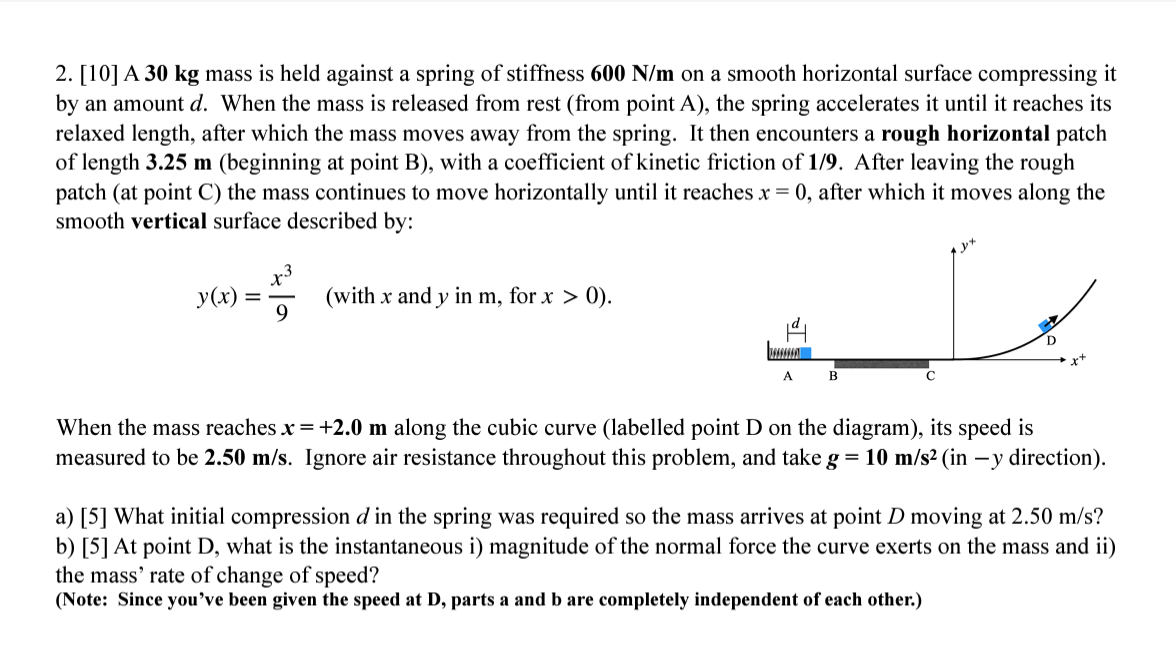
d. When the mass is released from rest (from point
A), the spring accelerates it until it reaches its relaxed length, after which the mass moves away from the spring. It then encounters a rough horizontal patch of length
3.25m(beginning at point
B), with a coefficient of kinetic friction of
(1)/(9). After leaving the rough patch (at point
C) the mass continues to move horizontally until it reaches
x=0, after which it moves along the smooth vertical surface described by:
y(x)=(x^(3))/(9),( with x and y in m, for x>0).When the mass reaches
x=+2.0malong the cubic curve (labelled point
Don the diagram), its speed is measured to be
2.50(m)/(s). Ignore air resistance throughout this problem, and take
g=10(m)/(s^(2))(in
-ydirection). a) [5] What initial compression
din the spring was required so the mass arrives at point
Dmoving at
2.50(m)/(s)? b) [5] At point
D, what is the instantaneous i) magnitude of the normal force the curve exerts on the mass and ii) the mass' rate of change of speed? (Note: Since you've been given the speed at
D, parts a and
bare completely independent of each other.)