Home /
Expert Answers /
Calculus /
2-calculus-question-6-use-a-int-1-1-x-2-1-dx-using-a-partition-of-1-1-into-4-equal-parts-qu-pa605
(Solved): 2 Calculus Question 6. Use a\int_(-1)^1 (x^(2)+1)dx using a partition of -1,1 into 4 equal parts. Qu ...
2 Calculus
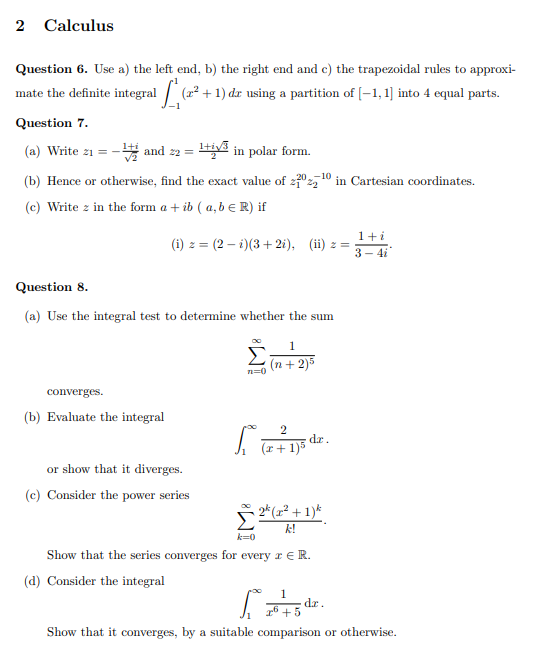
Question 6. Use a\int_(-1)^1 (x^(2)+1)dx using a partition of -1,1 into 4 equal parts.
Question 7.
(a) Write z_(1)=-(1+i)/(\sqrt(2)) and z_(2)=(1+i\sqrt(3))/(2) in polar form.
(b) Hence or otherwise, find the exact value of z_(1)^(20)z_(2)^(-10) in Cartesian coordinates.
(c) Write z in the form a+ib(a,binR) if
(i) z=(2-i)(3+2i),
(ii) z=(1+i)/(3-4i).
Question 8.
(a) Use the integral test to determine whether the sum
\sum_(n=0)^(\infty ) (1)/((n+2)^(5))
converges.
(b) Evaluate the integral
\int_1^(\infty ) (2)/((x+1)^(5))dx
or show that it diverges.
(c) Consider the power series
\sum_(k=0)^(\infty ) (2^(k)(x^(2)+1)^(k))/(k!)
Show that the series converges for every xinR.
(d) Consider the integral
\int_1^(\infty ) (1)/(x^(6)+5)dx
Show that it converges, by a suitable comparison or otherwise.