Home /
Expert Answers /
Advanced Physics /
2-the-duffing-equation-80-in-this-question-we-will-consider-a-damped-mass-on-a-spring-system-whos-pa704
(Solved): 2 The Duffing Equation [80%] In this question we will consider a damped mass-on-a-spring system whos ...
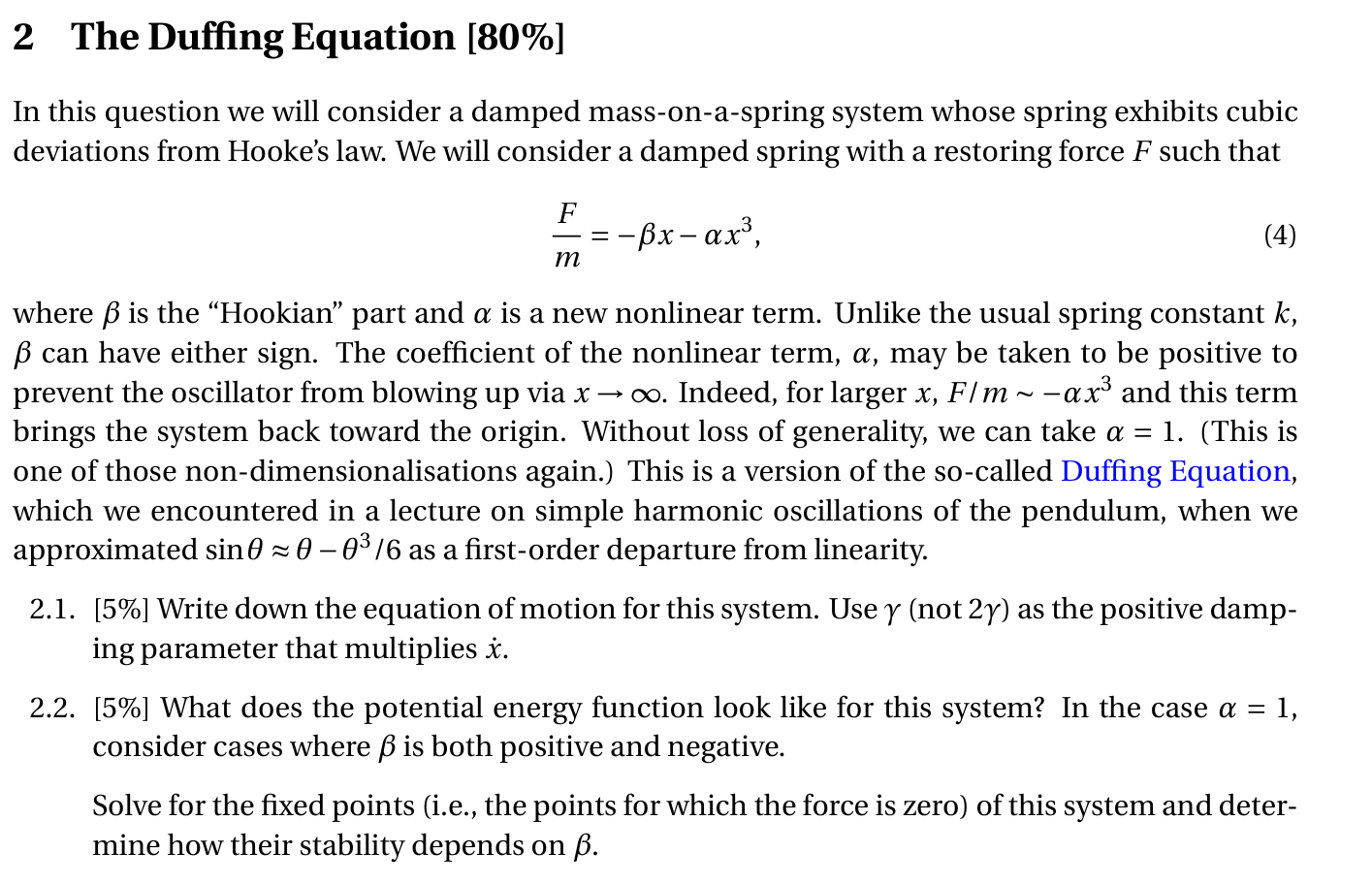
2 The Duffing Equation [80%]
In this question we will consider a damped mass-on-a-spring system whose spring exhibits cubic
deviations from Hooke's law. We will consider a damped spring with a restoring force F such that
(F)/(m)=-\beta x-\alpha x^(3),
where \beta is the "Hookian" part and \alpha is a new nonlinear term. Unlike the usual spring constant k,
\beta can have either sign. The coefficient of the nonlinear term, \alpha , may be taken to be positive to
prevent the oscillator from blowing up via x->\infty . Indeed, for larger x,(F)/(m)?-\alpha x^(3) and this term
brings the system back toward the origin. Without loss of generality, we can take \alpha =1. (This is
one of those non-dimensionalisations again.) This is a version of the so-called Duffing Equation,
which we encountered in a lecture on simple harmonic oscillations of the pendulum, when we
approximated sin\theta ~~\theta -(\theta ^(3))/(6) as a first-order departure from linearity.
2.1. [5%] Write down the equation of motion for this system. Use \gamma 2\gamma x^(?).
2.2. [5%] What does the potential energy function look like for this system? In the case \alpha =1,
consider cases where \beta is both positive and negative.
Solve for the fixed points (i.e., the points for which the force is zero) of this system and deter-
mine how their stability depends on \beta .