Home /
Expert Answers /
Advanced Math /
4-5-radially-symmetric-solutions-suppose-we-consider-the-3d-wave-equation-with-radially-symmetric-pa610
(Solved): 4.5 (Radially Symmetric Solutions) Suppose we consider the 3D wave equation with radially symmetric ...
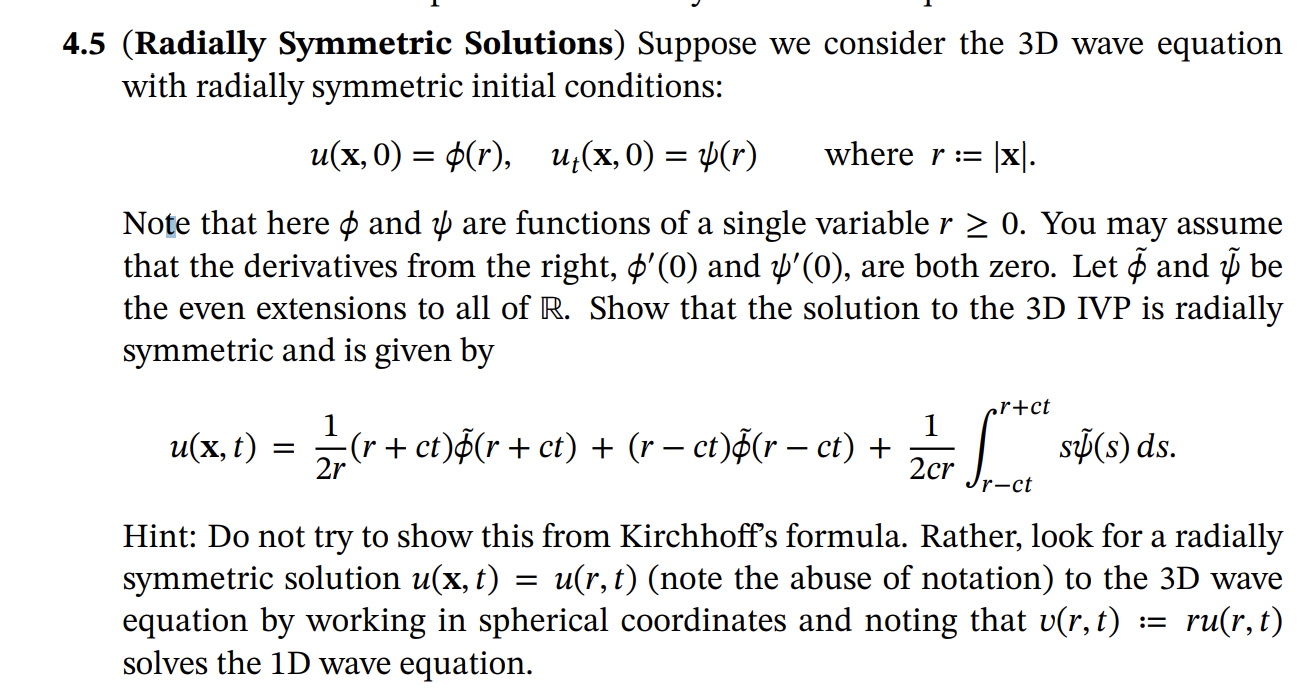
4.5 (Radially Symmetric Solutions) Suppose we consider the 3D wave equation
with radially symmetric initial conditions:
u(x,0)=\phi (r),u_(t)(x,0)=\psi (r), where r:=|x|
Note that here \phi and \psi are functions of a single variable r>=0. You may assume
that the derivatives from the right, \phi ^(')(0) and \psi ^(')(0), are both zero. Let tilde(\phi ) and tilde(\psi ) be
the even extensions to all of R. Show that the solution to the 3D IVP is radially
symmetric and is given by
u(x,t)=(1)/(2r)(r+ct)tilde(\phi )(r+ct)+(r-ct)tilde(\phi )(r-ct)+(1)/(2cr)\int_(r-ct)^(r+ct) stilde(\psi )(s)ds
Hint: Do not try to show this from Kirchhoff's formula. Rather, look for a radially
symmetric solution u(x,t)=u(r,t) (note the abuse of notation) to the 3D wave
equation by working in spherical coordinates and noting that v(r,t):=ru(r,t)
solves the 1D wave equation.