Home /
Expert Answers /
Economics /
4-irrigation-in-many-small-african-villages-farmers-share-a-common-irrigation-system-the-maintena-pa428
(Solved): 4. Irrigation In many small African villages farmers share a common irrigation system. The maintena ...
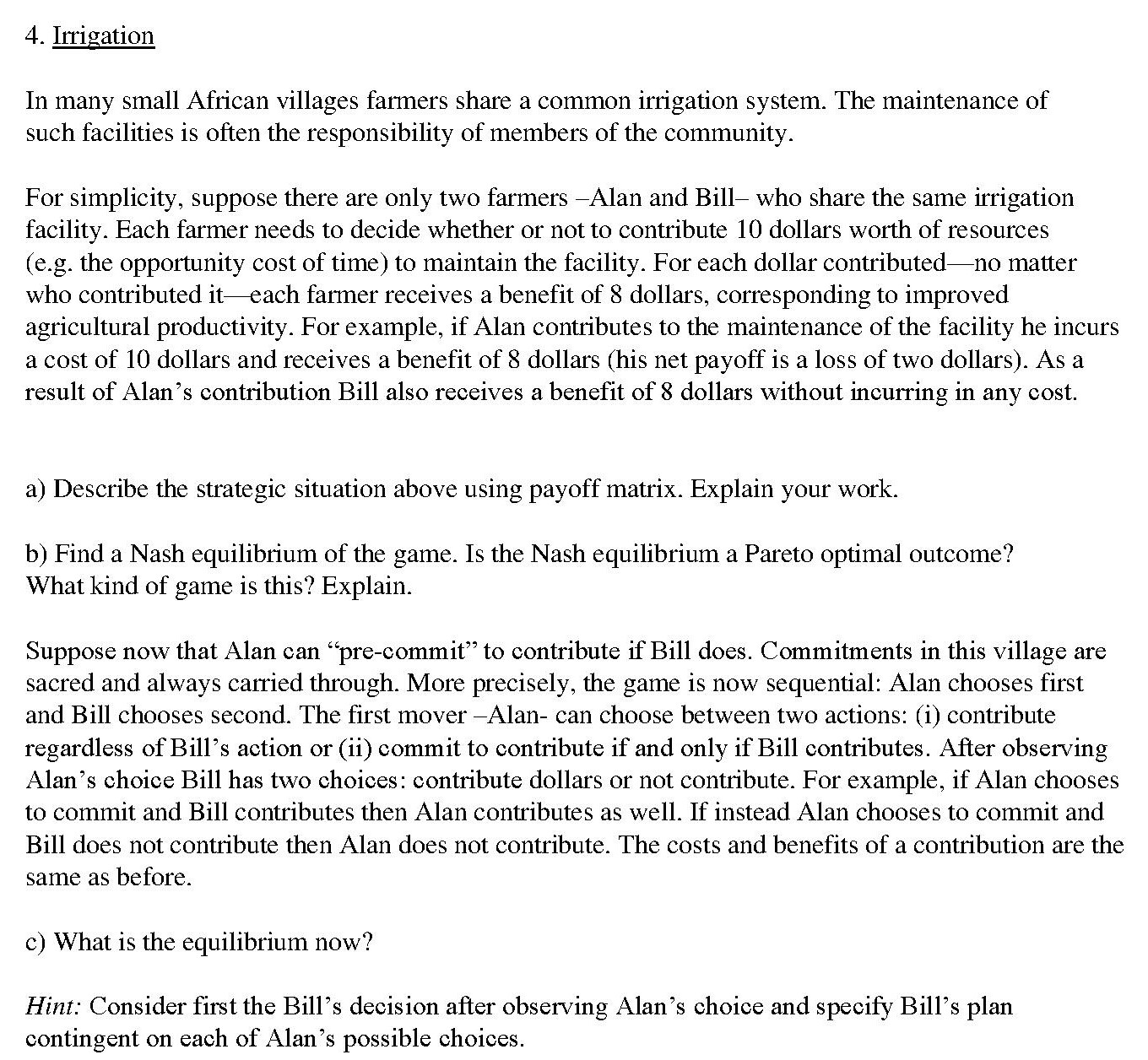
4. Irrigation In many small African villages farmers share a common irrigation system. The maintenance of such facilities is often the responsibility of members of the community. For simplicity, suppose there are only two farmers - Alan and Bill- who share the same irrigation facility. Each farmer needs to decide whether or not to contribute 10 dollars worth of resources (e.g. the opportunity cost of time) to maintain the facility. For each dollar contributed - no matter who contributed it - each farmer receives a benefit of 8 dollars, corresponding to improved agricultural productivity. For example, if Alan contributes to the maintenance of the facility he incurs a cost of 10 dollars and receives a benefit of 8 dollars (his net payoff is a loss of two dollars). As a result of Alan's contribution Bill also receives a benefit of 8 dollars without incurring in any cost. a) Describe the strategic situation above using payoff matrix. Explain your work. b) Find a Nash equilibrium of the game. Is the Nash equilibrium a Pareto optimal outcome? What kind of game is this? Explain. Suppose now that Alan can "pre-commit" to contribute if Bill does. Commitments in this village are sacred and always carried through. More precisely, the game is now sequential: Alan chooses first and Bill chooses second. The first mover -Alan- can choose between two actions: (i) contribute regardless of Bill's action or (ii) commit to contribute if and only if Bill contributes. After observing Alan's choice Bill has two choices: contribute dollars or not contribute. For example, if Alan chooses to commit and Bill contributes then Alan contributes as well. If instead Alan chooses to commit and Bill does not contribute then Alan does not contribute. The costs and benefits of a contribution are the same as before. c) What is the equilibrium now? Hint: Consider first the Bill's decision after observing Alan's choice and specify Bill's plan contingent on each of Alan's possible choices.