(Solved): A compressive load P is applied parallel to the x axis of the slender, rectangular aluminium-alloy ...
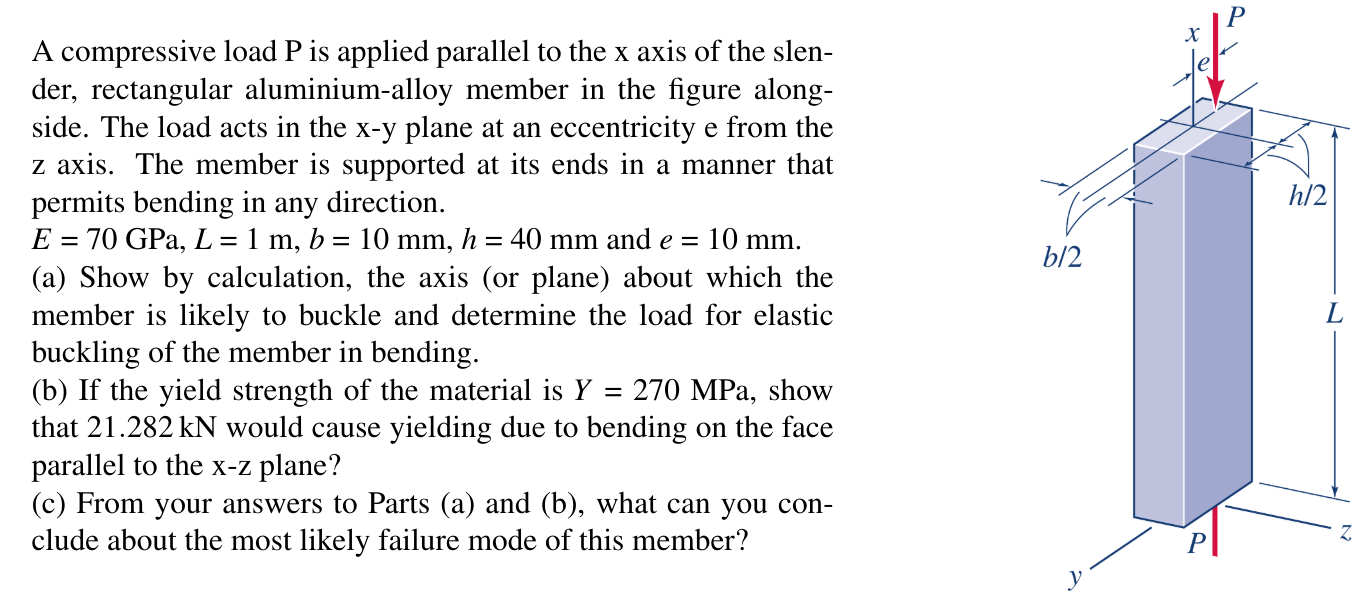
A compressive load P is applied parallel to the x axis of the slender, rectangular aluminium-alloy member in the figure alongside. The load acts in the x-y plane at an eccentricity e from the z axis. The member is supported at its ends in a manner that permits bending in any direction. E = 70 GPa, L = 1 m, b = 10 mm, h = 40 mm and e = 10 mm. (a) Show by calculation, the axis (or plane) about which the member is likely to buckle and determine the load for elastic buckling of the member in bending. (b) If the yield strength of the material is Y = 270 MPa, show that 21.282 kN would cause yielding due to bending on the face parallel to the x-z plane? (c) From your answers to Parts (a) and (b), what can you conclude about the most likely failure mode of this member? A compressive load
Pis applied parallel to the
xaxis of the slen- der, rectangular aluminium-alloy member in the figure along- side. The load acts in the x-y plane at an eccentricity e from the
zaxis. The member is supported at its ends in a manner that permits bending in any direction.
E=70GPa,L=1m,b=10mm,h=40mmand
e=10mm. (a) Show by calculation, the axis (or plane) about which the member is likely to buckle and determine the load for elastic buckling of the member in bending. (b) If the yield strength of the material is
Y=270MPa, show that
21.282kNwould cause yielding due to bending on the face parallel to the x-z plane? (c) From your answers to Parts (a) and (b), what can you con- clude about the most likely failure mode of this member?