(Solved): A double-blind, randomized comparative experiment compared the effect of the drug lorcaserin and a ...
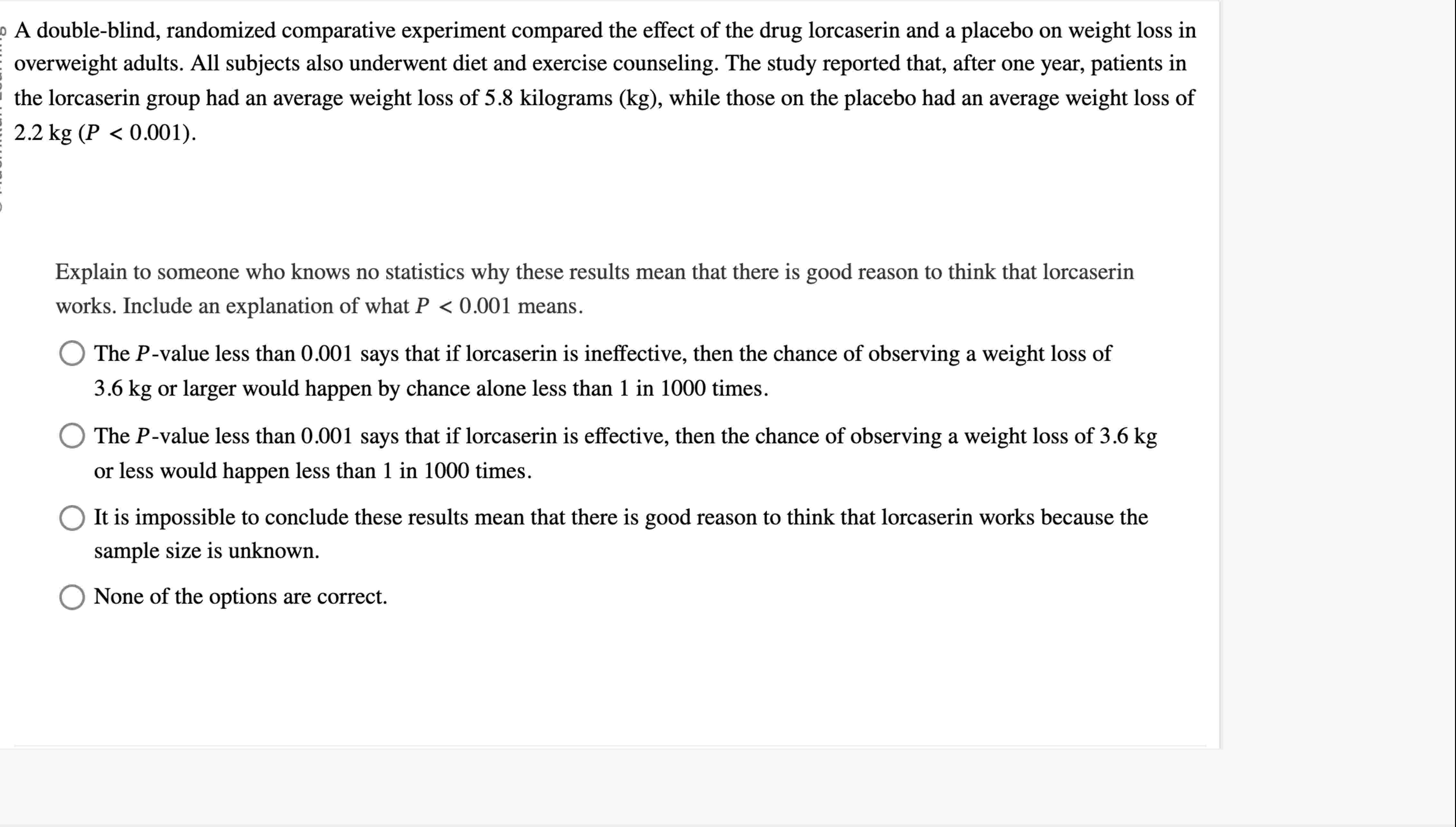
A double-blind, randomized comparative experiment compared the effect of the drug lorcaserin and a placebo on weight loss in overweight adults. All subjects also underwent diet and exercise counseling. The study reported that, after one year, patients in the lorcaserin group had an average weight loss of 5.8 kilograms \( (\mathrm{kg}) \), while those on the placebo had an average weight loss of \( 2.2 \mathrm{~kg}(P<0.001) \). Explain to someone who knows no statistics why these results mean that there is good reason to think that lorcaserin works. Include an explanation of what \( P<0.001 \) means. The \( P \)-value less than 0.001 says that if lorcaserin is ineffective, then the chance of observing a weight loss of 3.6 kg or larger would happen by chance alone less than 1 in 1000 times. The \( P \)-value less than 0.001 says that if lorcaserin is effective, then the chance of observing a weight loss of 3.6 kg or less would happen less than 1 in 1000 times. It is impossible to conclude these results mean that there is good reason to think that lorcaserin works because the sample size is unknown. None of the options are correct.