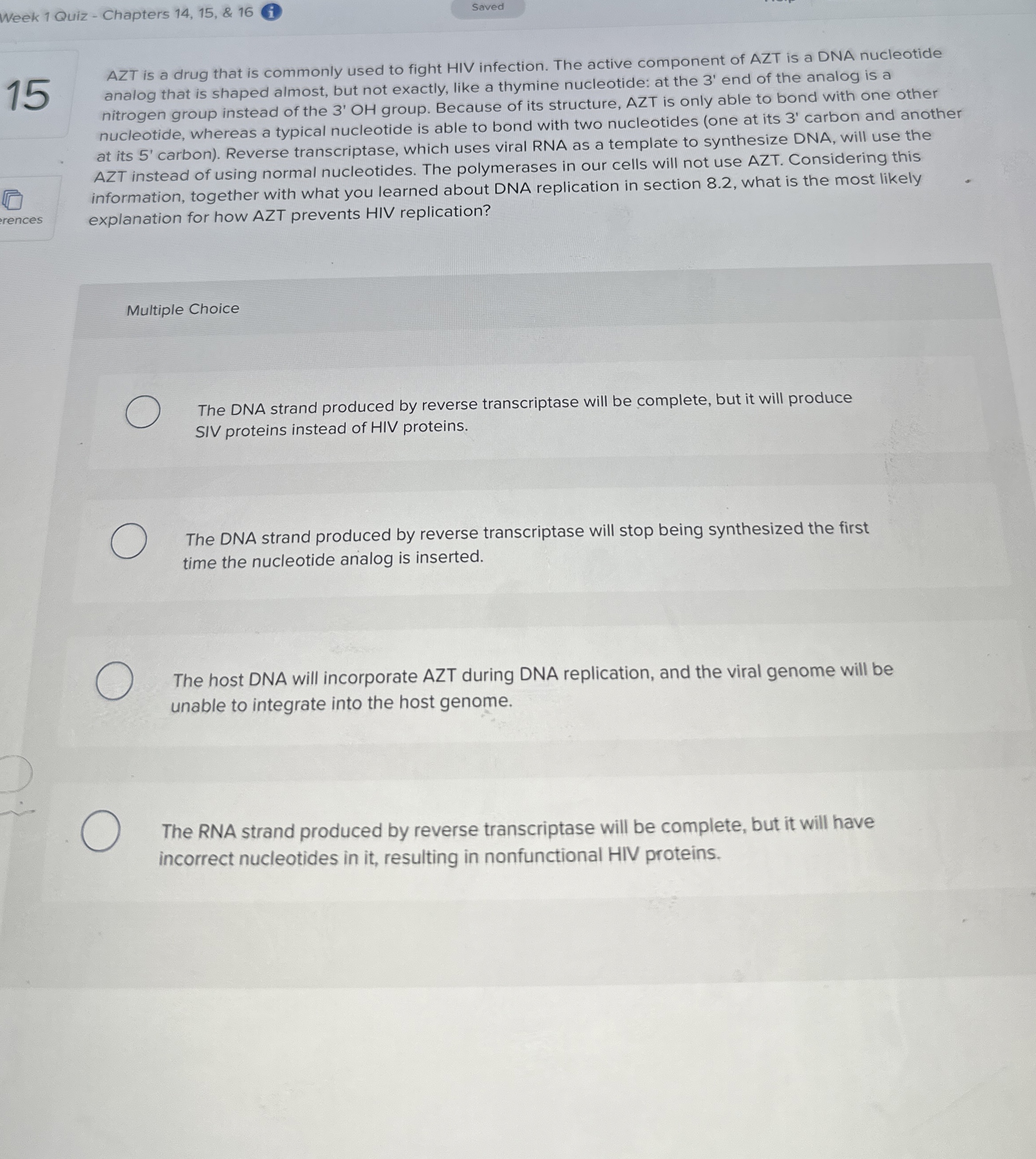
(Solved): AZT is a drug that is commonly used to fight HIV infection. The active component of AZT is a DNA nuc ...
AZT is a drug that is commonly used to fight HIV infection. The active component of AZT is a DNA nucleotide analog that is shaped almost, but not exactly, like a thymine nucleotide: at the
3^(')end of the analog is a nitrogen group instead of the
3^(')OHgroup. Because of its structure, AZT is only able to bond with one other nucleotide, whereas a typical nucleotide is able to bond with two nucleotides (one at its
3^(')carbon and another at its
5^(')carbon). Reverse transcriptase, which uses viral RNA as a template to synthesize DNA, will use the AZT instead of using normal nucleotides. The polymerases in our cells will not use AZT. Considering this information, together with what you learned about DNA replication in section 8.2, what is the most likely explanation for how AZT prevents HIV replication? Multiple Choice The DNA strand produced by reverse transcriptase will be complete, but it will produce SIV proteins instead of HIV proteins. The DNA strand produced by reverse transcriptase will stop being synthesized the first time the nucleotide analog is inserted. The host DNA will incorporate AZT during DNA replication, and the viral genome will be unable to integrate into the host genome. The RNA strand produced by reverse transcriptase will be complete, but it will have incorrect nucleotides in it, resulting in nonfunctional HIV proteins.