Home /
Expert Answers /
Economics /
consider-the-following-principal-agent-problem-where-only-two-outcomes-and-valued-at-50-000-and-25-pa400
(Solved): Consider the following principal-agent problem where only two outcomes, and valued at 50,000 and 25, ...
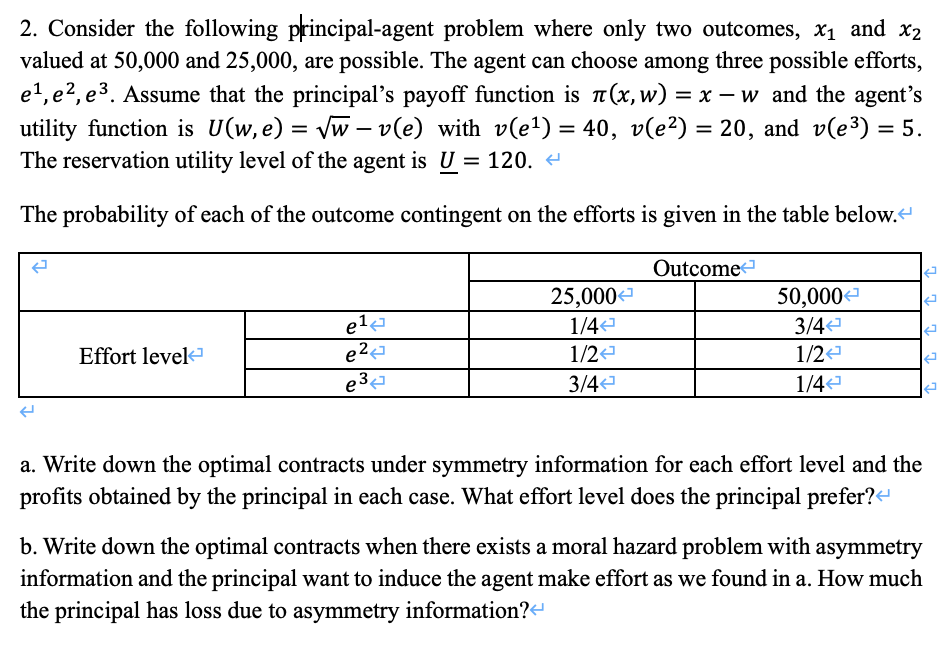
Consider the following principal-agent problem where only two outcomes, and valued at 50,000 and 25,000, are possible. The agent can choose among three possible efforts, . Assume that the principal’s payoff function is and the agent’s utility function is with , , and . The reservation utility level of the agent is .
The probability of each of the outcome contingent on the efforts is given in the table below.

Outcome
25,000
50,000
Effort level

(1)/(4)
(3)/(4)

(1)/(2)
(1)/(2)

(3)/(4)
(1)/(4)

a. Write down the optimal contracts under symmetry information for each effort level and the profits obtained by the principal in each case. What effort level does the principal prefer?
b. Write down the optimal contracts when there exists a moral hazard problem with asymmetry information and the principal want to induce the agent make effort as we found in a. How much the principal has loss due to asymmetry information?
Consider the following ptrincipal-agent problem where only two outcomes, x_(1) and x_(2)
valued at 50,000 and 25,000, are possible. The agent can choose among three possible efforts,
e^(1),e^(2),e^(3). Assume that the principal's payoff function is \pi (x,w)=x-w and the agent's
utility function is U(w,e)=\sqrt(w)-v(e) with v(e^(1))=40,v(e^(2))=20, and v(e^(3))=5.
The reservation utility level of the agent is U_()=120.
The probability of each of the outcome contingent on the efforts is given in the table below.
a. Write down the optimal contracts under symmetry information for each effort level and the
profits obtained by the principal in each case. What effort level does the principal prefer?
b. Write down the optimal contracts when there exists a moral hazard problem with asymmetry
information and the principal want to induce the agent make effort as we found in a. How much
the principal has loss due to asymmetry information?