(Solved): Describing Colonial Morphology of Bacteria By looking closely at the colonial growth on the surface ...
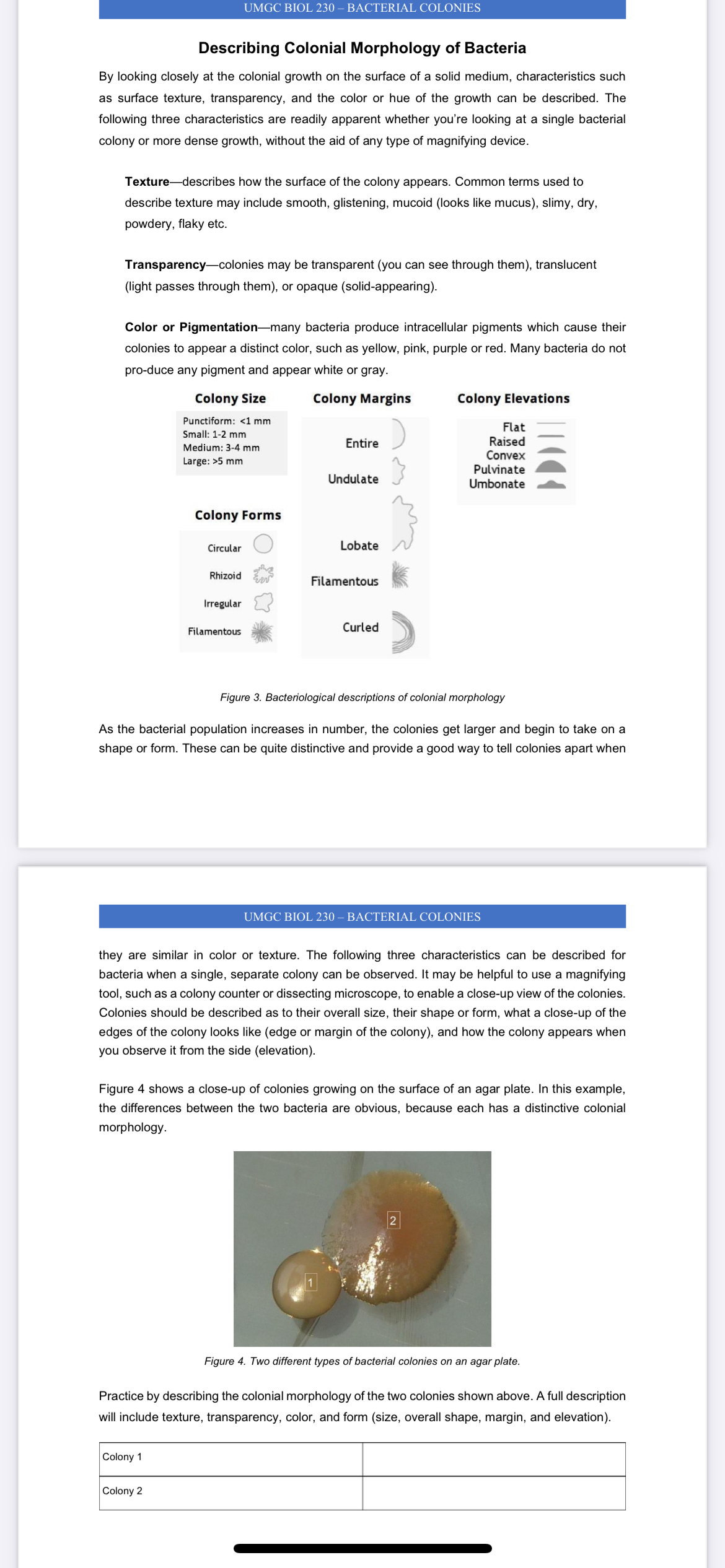
Describing Colonial Morphology of Bacteria By looking closely at the colonial growth on the surface of a solid medium, characteristics such as surface texture, transparency, and the color or hue of the growth can be described. The following three characteristics are readily apparent whether you're looking at a single bacterial colony or more dense growth, without the aid of any type of magnifying device. Texture-describes how the surface of the colony appears. Common terms used to describe texture may include smooth, glistening, mucoid (looks like mucus), slimy, dry, powdery, flaky etc. Transparency-colonies may be transparent (you can see through them), translucent (light passes through them), or opaque (solid-appearing). Color or Pigmentation-many bacteria produce intracellular pigments which cause their colonies to appear a distinct color, such as yellow, pink, purple or red. Many bacteria do not pro-duce any pigment and appear white or gray. Figure 3. Bacteriological descriptions of colonial morphology As the bacterial population increases in number, the colonies get larger and begin to take on a shape or form. These can be quite distinctive and provide a good way to tell colonies apart when UMGC BIOL 230 - BACTERIAL COLONIES they are similar in color or texture. The following three characteristics can be described for bacteria when a single, separate colony can be observed. It may be helpful to use a magnifying tool, such as a colony counter or dissecting microscope, to enable a close-up view of the colonies. Colonies should be described as to their overall size, their shape or form, what a close-up of the edges of the colony looks like (edge or margin of the colony), and how the colony appears when you observe it from the side (elevation). Figure 4 shows a close-up of colonies growing on the surface of an agar plate. In this example, the differences between the two bacteria are obvious, because each has a distinctive colonial morphology. Figure 4. I wo ditterent types of bacterial colonies on an agar plate. Practice by describing the colonial morphology of the two colonies shown above. A full description will include texture, transparency, color, and form (size, overall shape, margin, and elevation). Colony 1 Colony 2