(Solved): Determine the slope of the best-fit straight line for the data. You are conducting an experiment in ...
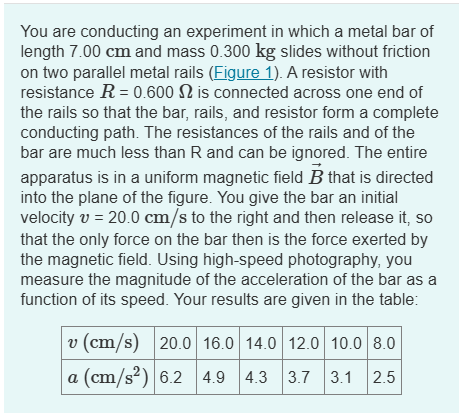
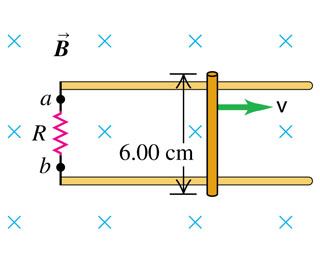
Determine the slope of the best-fit straight line for the data. You are conducting an experiment in which a metal bar of length 7.00 cm and mass 0.300 kg slides without friction on two parallel metal rails (Figure 1). A resistor with resistance \( R=0.600 \Omega \) is connected across one end of the rails so that the bar, rails, and resistor form a complete conducting path. The resistances of the rails and of the bar are much less than R and can be ignored. The entire apparatus is in a uniform magnetic field \( \vec{B} \) that is directed into the plane of the figure. You give the bar an initial velocity \( v=20.0 \mathrm{~cm} / \mathrm{s} \) to the right and then release it, so that the only force on the bar then is the force exerted by the magnetic field. Using high-speed photography, you measure the magnitude of the acceleration of the bar as a function of its speed. Your results are given in the table: