Home /
Expert Answers /
Electrical Engineering /
discrete-time-signals-and-systems-2-periodicity-suppose-that-the-signals-x-1-n-x-2-n-and-x-3-pa145
(Solved): Discrete Time Signals and Systems 2. Periodicity Suppose that the signals x_(1)[n],x_(2)[n] and x_(3 ...
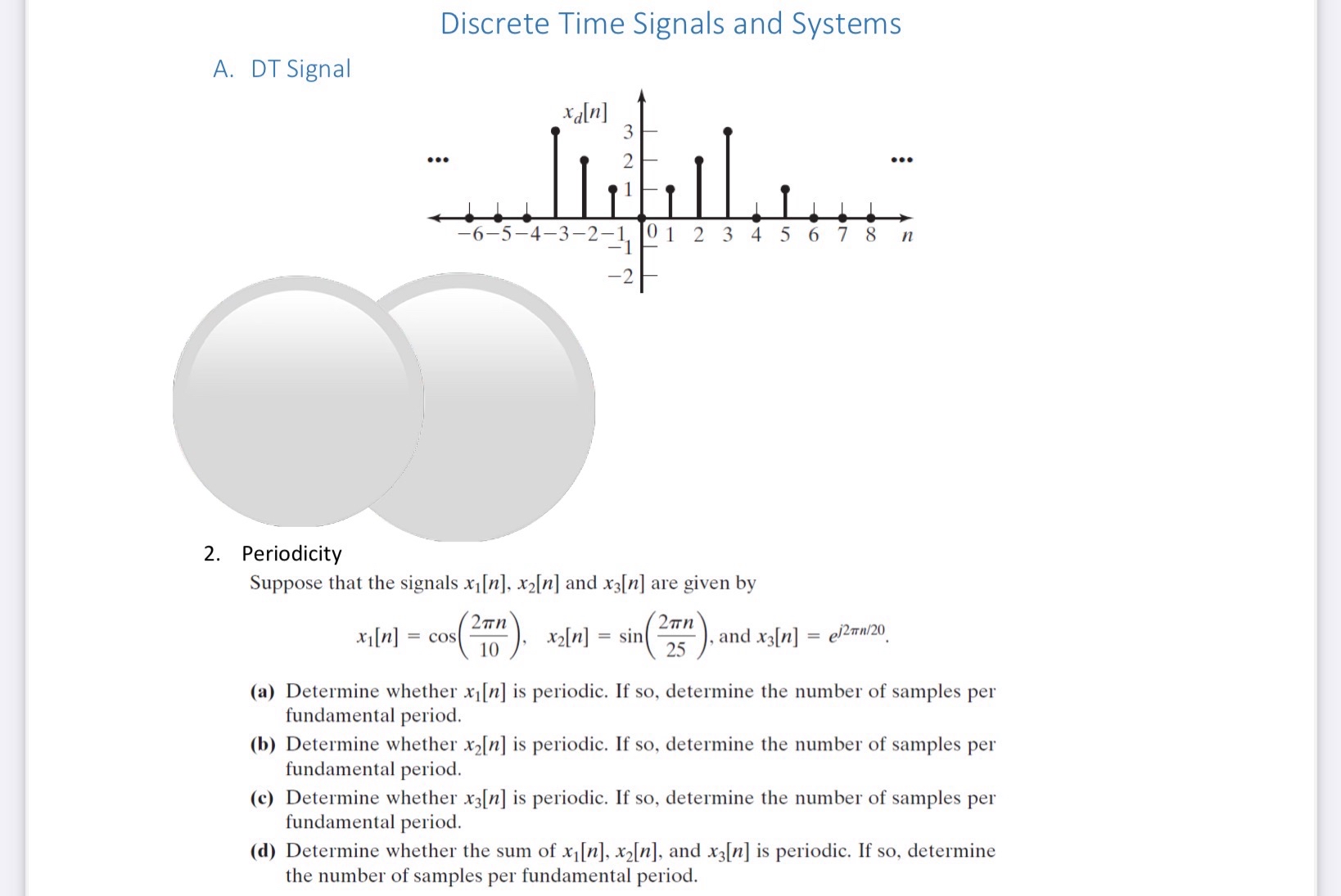
Discrete Time Signals and Systems 2. Periodicity Suppose that the signals
x_(1)[n],x_(2)[n]and
x_(3)[n]are given by
x_(1)[n]=cos((2\pi n)/(10)),x_(2)[n]=sin((2\pi n)/(25)), and x_(3)[n]=e^(j2\pi (n)/(20))(a) Determine whether
x_(1)[n]is periodic. If so, determine the number of samples per fundamental period. (b) Determine whether
x_(2)[n]is periodic. If so, determine the number of samples per fundamental period. (c) Determine whether
x_(3)[n]is periodic. If so, determine the number of samples per fundamental period. (d) Determine whether the sum of
x_(1)[n],x_(2)[n], and
x_(3)[n]is periodic. If so, determine the number of samples per fundamental period.