(Solved): Exact calculation of a three-spin Ising model (Open boundary condition): The Hamil- tonian is H_(3 ...
Exact calculation of a three-spin Ising model (Open boundary condition): The Hamil- tonian is
H_(3 spins )=-J(s_(1)s_(2)+s_(2)s_(3)),s_(i)=+-1. Now consider an Ising chain with
Nspins. Let's assume we ignore the boundary effects.
H({s_(i)})=-J\sum_i s_(i)s_(i+1). Here
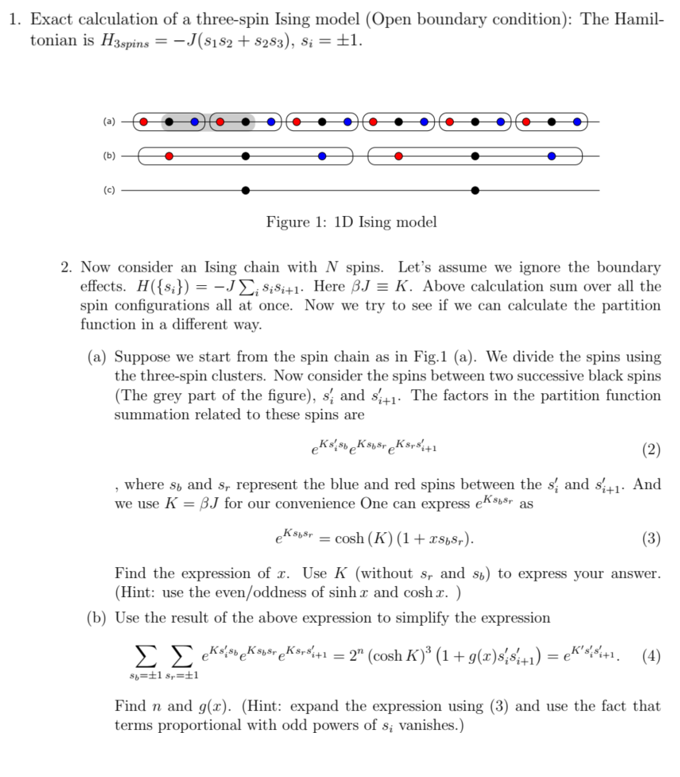
\beta J-=K. Above calculation sum over all the spin configurations all at once. Now we try to see if we can calculate the partition function in a different way. (a) Suppose we start from the spin chain as in Fig. 1 (a). We divide the spins using the three-spin clusters. Now consider the spins between two successive black spins (The grey part of the figure),
s_(i)^(')and
s_(i+1)^('). The factors in the partition function summation related to these spins are
e^(Ks_(i)^(')s_(b))e^(Ks_(b)s_(r))e^(Ks_(r)s_(i+1)^(')), where
s_(b)and
s_(r)represent the blue and red spins between the
s_(i)^(')and
s_(i+1)^('). And we use
K=\beta Jfor our convenience One can express
e^(Ks_(b)s_(r))as
e^(Ks_(b)s_(r))=cosh(K)(1+xs_(b)s_(r)).Find the expression of
x. Use
K(without
s_(r)and
s_(b)) to express your answer. (Hint: use the even/oddness of
sinhxand
coshx. ) (b) Use the result of the above expression to simplify the expression
\sum_(s_(b)=+-1) \sum_(s_(r)=+-1) e^(Ks_(i)^(')s_(b))e^(Ks_(b)s_(r))e^(Ks_(r)s_(i+1)^('))=2^(n)(coshK)^(3)(1+g(x)s_(i)^(')s_(i+1)^('))=e^(K^(')s_(i)^(')s_(i+1)^(')).Find
nand
g(x). (Hint: expand the expression using (3) and use the fact that terms proportional with odd powers of
s_(i)vanishes.)