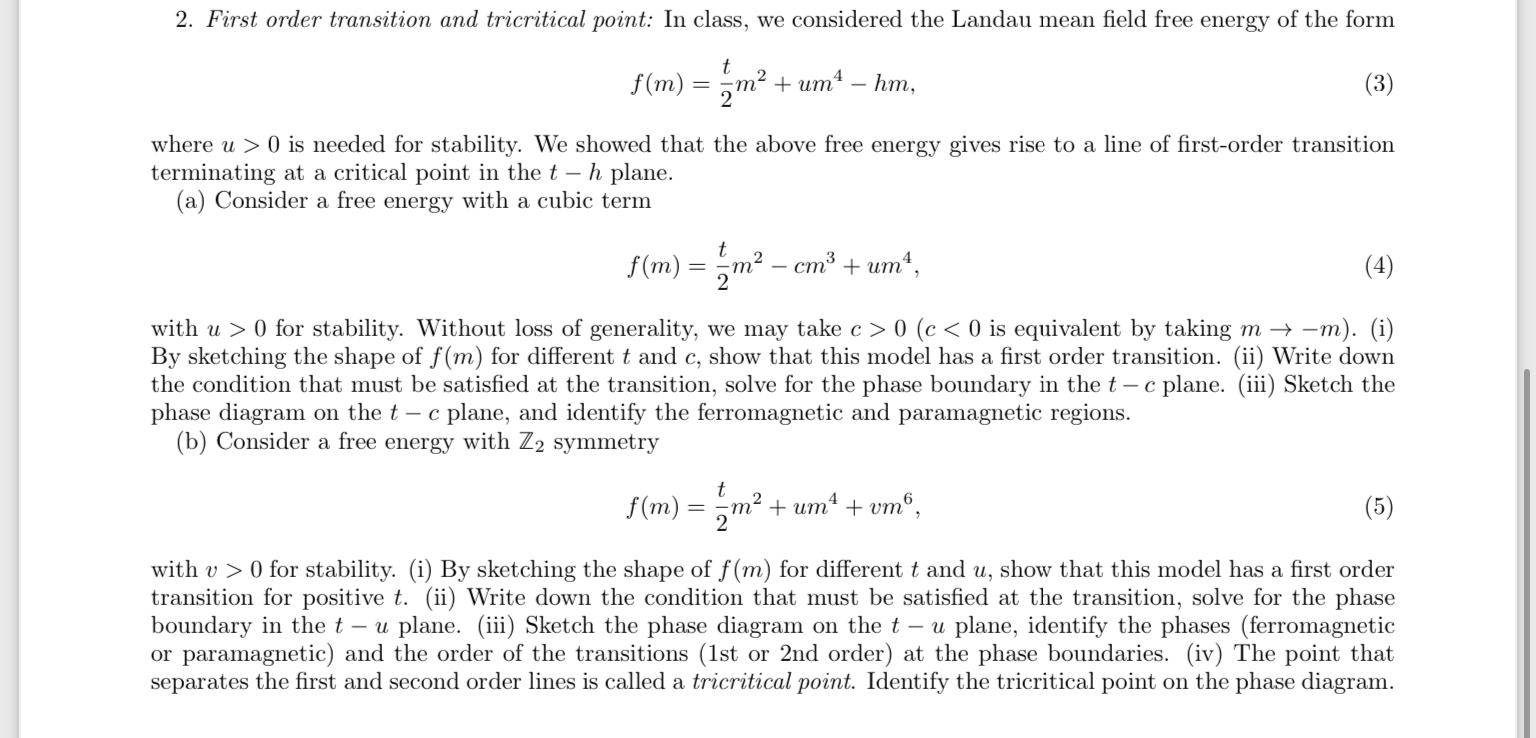
(Solved): First order transition and tricritical point: In class, we considered the Landau mean field free ene ...
First order transition and tricritical point: In class, we considered the Landau mean field free energy of the form
f(m)=(t)/(2)m^(2)+um^(4)-hmwhere
u>0is needed for stability. We showed that the above free energy gives rise to a line of first-order transition terminating at a critical point in the
t-hplane. (a) Consider a free energy with a cubic term
f(m)=(t)/(2)m^(2)-cm^(3)+um^(4)with
u>0for stability. Without loss of generality, we may take is equivalent by taking
m->-m. (i) By sketching the shape of
f(m)for different
tand
c, show that this model has a first order transition. (ii) Write down the condition that must be satisfied at the transition, solve for the phase boundary in the
t-cplane. (iii) Sketch the phase diagram on the
t-cplane, and identify the ferromagnetic and paramagnetic regions. (b) Consider a free energy with
Z_(2)symmetry
f(m)=(t)/(2)m^(2)+um^(4)+vm^(6)with
v>0for stability. (i) By sketching the shape of
f(m)for different
tand
u, show that this model has a first order transition for positive
t. (ii) Write down the condition that must be satisfied at the transition, solve for the phase boundary in the
t-uplane. (iii) Sketch the phase diagram on the
t-uplane, identify the phases (ferromagnetic or paramagnetic) and the order of the transitions (1st or 2 nd order) at the phase boundaries. (iv) The point that separates the first and second order lines is called a tricritical point. Identify the tricritical point on the phase diagram.