(Solved): For the stepped cantilever beam shown, using Interval Finite Element Analysis, obtain the bounds of ...
For the stepped cantilever beam shown, using Interval Finite Element Analysis, obtain the bounds of the vertical displacement at the free end, as well as the bounds of the fundamental natural circular frequency. For this project, the modulus of Elasticity,
E, possesses interval uncertainty The modulus of Elasticity of each of the four beam segments should be considered as separate independent interval variables. The interval for each segment should be:
0.9E,1.1E. To perform interval finite element analysis, perform deterministic analyses for all combinations of upper and lower bounds for each interval variable. The interval bounds will be the maximum and minimum results found from the evaluation of all such combinations. Structural Notes: The stepped Cantilever Beam is made of cross laminated timber (CLT) The species of wood is Douglas Fir:
E=1,720,000psi Douglas Fir has a density:
\rho =33pcfThe shallowest section has an area of
A=16in^(2)The shallowest section has a moment of inertia
I=85in
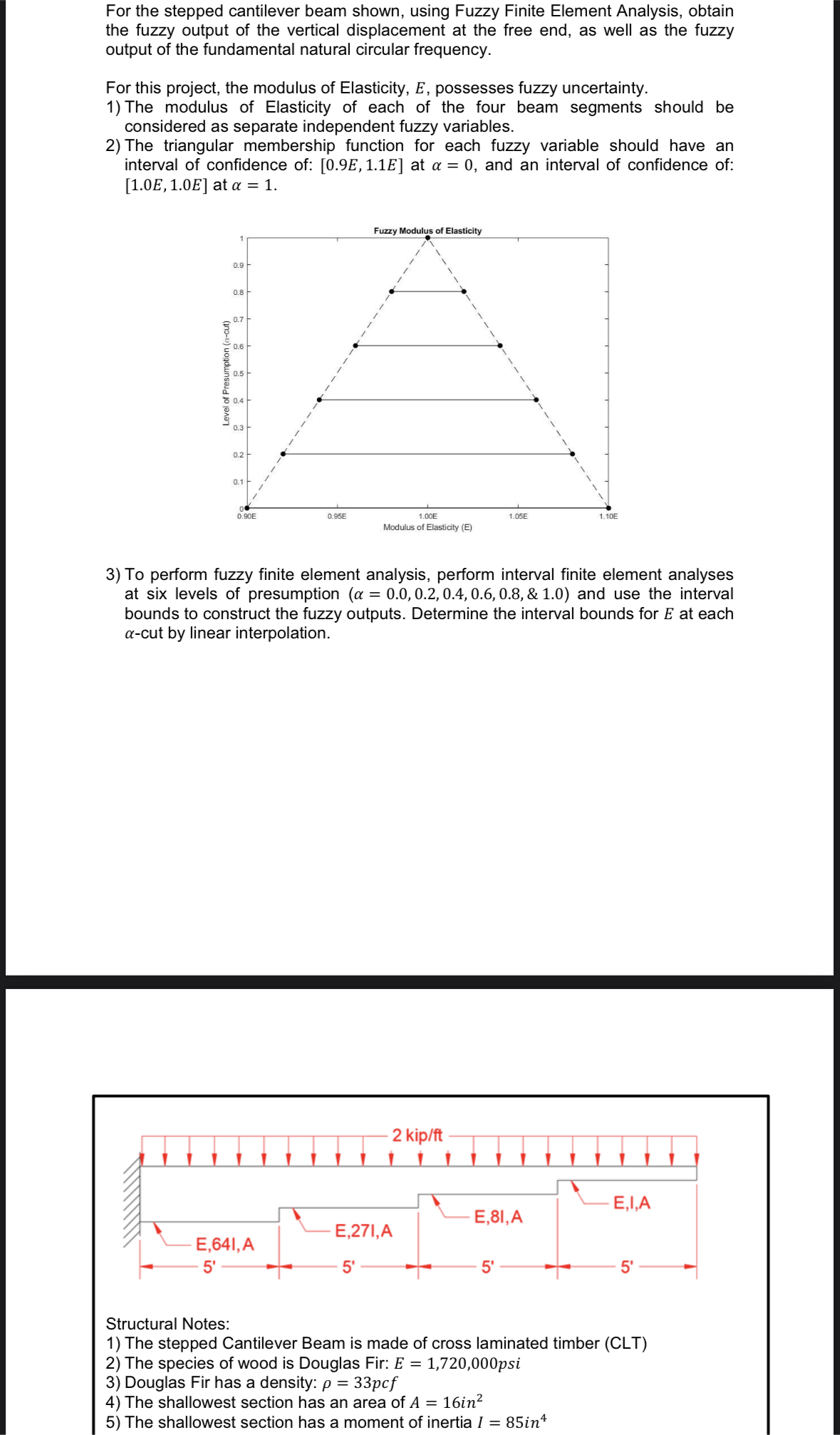
^(4)For the stepped cantilever beam shown, using Fuzzy Finite Element Analysis, obtain the fuzzy output of the vertical displacement at the free end, as well as the fuzzy output of the fundamental natural circular frequency. For this project, the modulus of Elasticity,
E, possesses fuzzy uncertainty. The modulus of Elasticity of each of the four beam segments should be considered as separate independent fuzzy variables. The triangular membership function for each fuzzy variable should have an interval of confidence of:
0.9E,1.1Eat
\alpha =0, and an interval of confidence of:
1.0E,1.0Eat
\alpha =1. To perform fuzzy finite element analysis, perform interval finite element analyses at six levels of presumption (
\alpha =0.0,0.2,0.4,0.6,0.8,&1.0) and use the interval bounds to construct the fuzzy outputs. Determine the interval bounds for
Eat each
\alpha -cut by linear interpolation. Structural Notes: The stepped Cantilever Beam is made of cross laminated timber (CLT) The species of wood is Douglas Fir:
E=1,720,000psi Douglas Fir has a density:
\rho =33pcfThe shallowest section has an area of
A=16in^(2)The shallowest section has a moment of inertia
I=85in^(4)