(Solved): If the serine phosphorylated by Protein Kinase \( A(P K A) \) on phosphofructokinase- 2 (PFK2) were ...
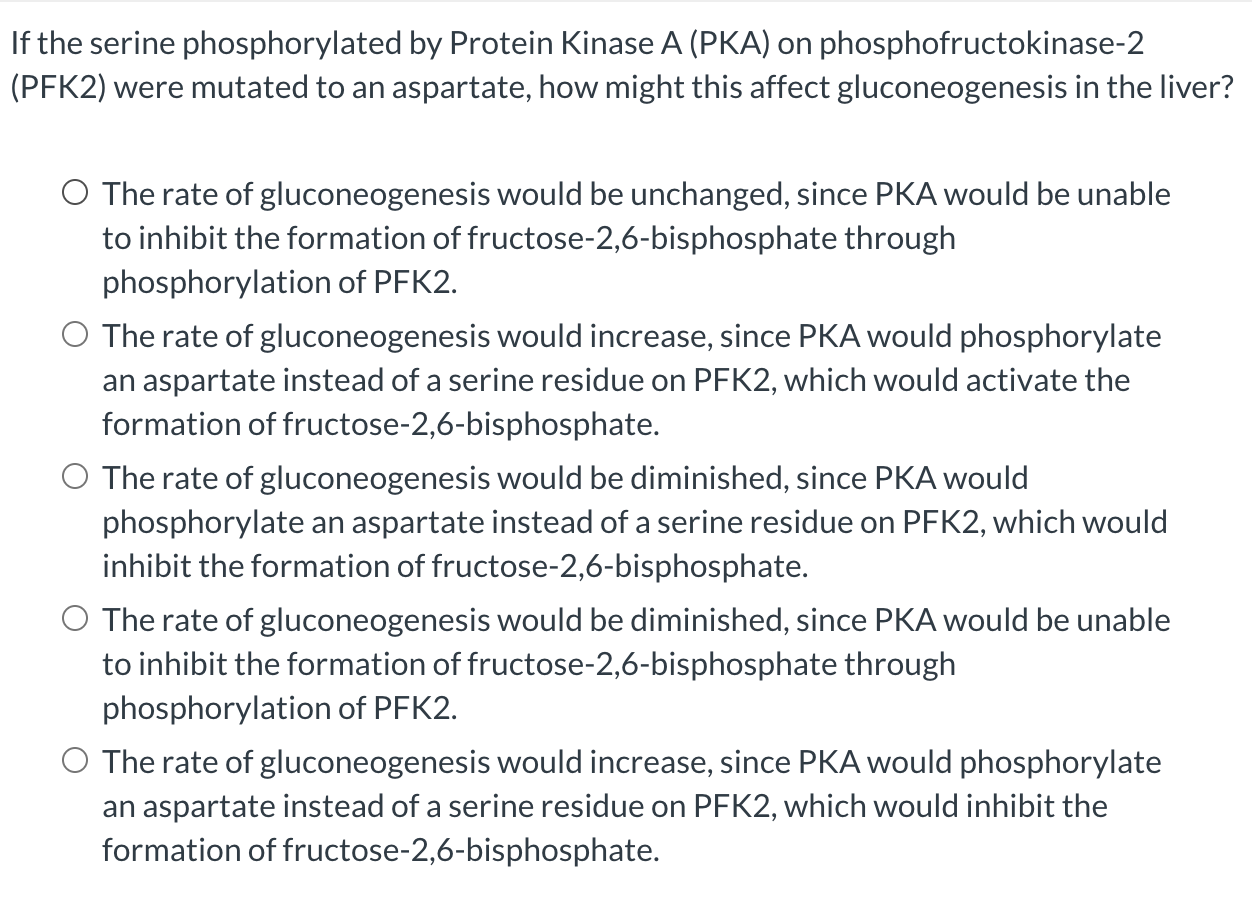
If the serine phosphorylated by Protein Kinase \( A(P K A) \) on phosphofructokinase- 2 (PFK2) were mutated to an aspartate, how might this affect gluconeogenesis in the liver? The rate of gluconeogenesis would be unchanged, since PKA would be unable to inhibit the formation of fructose-2,6-bisphosphate through phosphorylation of PFK2. The rate of gluconeogenesis would increase, since PKA would phosphorylate an aspartate instead of a serine residue on PFK2, which would activate the formation of fructose-2,6-bisphosphate. The rate of gluconeogenesis would be diminished, since PKA would phosphorylate an aspartate instead of a serine residue on PFK2, which would inhibit the formation of fructose-2,6-bisphosphate. The rate of gluconeogenesis would be diminished, since PKA would be unable to inhibit the formation of fructose-2,6-bisphosphate through phosphorylation of PFK2. The rate of gluconeogenesis would increase, since PKA would phosphorylate an aspartate instead of a serine residue on PFK2, which would inhibit the formation of fructose-2,6-bisphosphate.