Home /
Expert Answers /
Other /
in-the-1990s-ben-amp-jerry-s-founders-developed-a-five-to-one-salary-ratio-rule-rule-which-meant-tha
(Solved): In the 1990s, Ben & Jerry's founders developed a five-to-one salary ratio rule ("Rule"), which ...
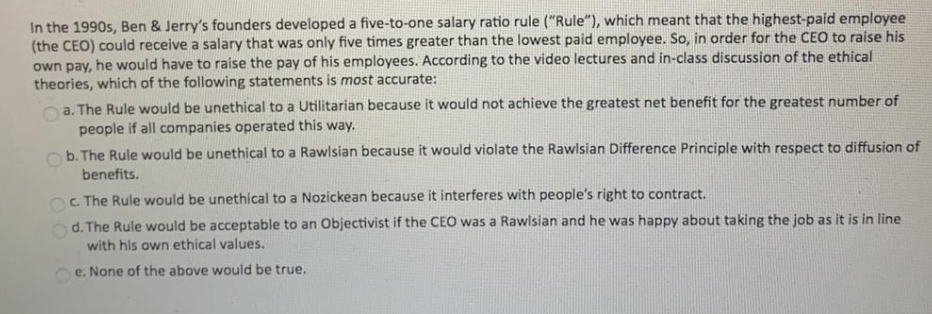
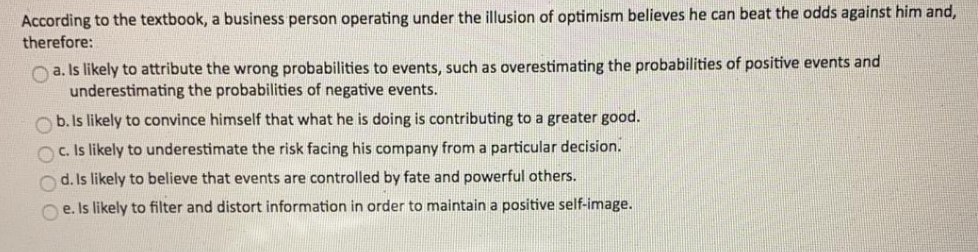
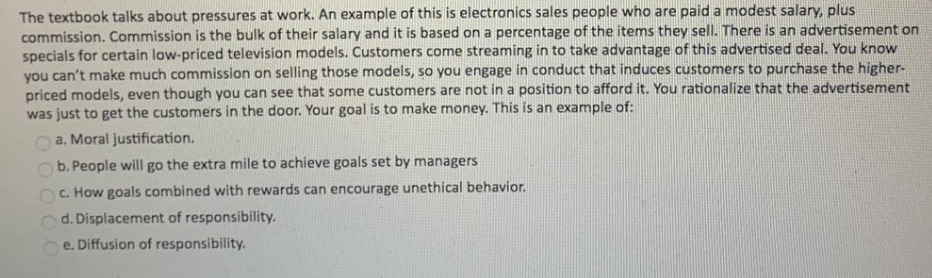
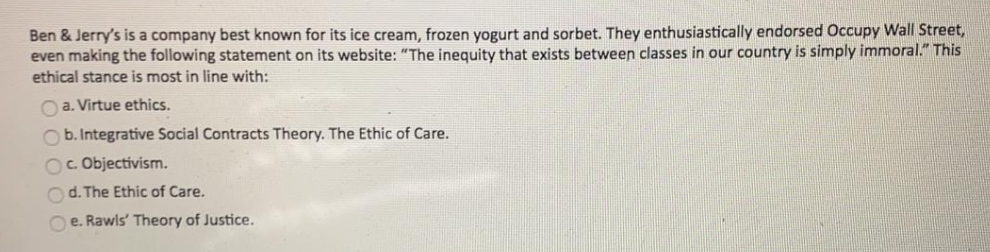
In the 1990s, Ben & Jerry's founders developed a five-to-one salary ratio rule ("Rule"), which meant that the highest-paid employee (the CEO) could receive a salary that was only five times greater than the lowest paid employee. So, in order for the CEO to raise his own pay, he would have to raise the pay of his employees. According to the video lectures and in-class discussion of the ethical theories, which of the following statements is most accurate: a. The Rule would be unethical to a Utilitarian because it would not achieve the greatest net benefit for the greatest number of people if all companies operated this way. b. The Rule would be unethical to a Rawlsian because it would violate the Rawlsian Difference Principle with respect to diffusion of benefits. c. The Rule would be unethical to a Nozickean because it interferes with people's right to contract. d. The Rule would be acceptable to an Objectivist if the CEO was a Rawisian and he was happy about taking the job as it is in line with his own ethical values. e. None of the above would be true. According to the textbook, a business person operating under the illusion of optimism believes he can beat the odds against him and, therefore: a. Is likely to attribute the wrong probabilities to events, such as overestimating the probabilities of positive events and underestimating the probabilities of negative events. b. is likely to convince himself that what he is doing is contributing to a greater good. c. Is likely to underestimate the risk facing his company from a particular decision. d. Is likely to believe that events are controlled by fate and powerful others. e. Is likely to filter and distort information in order to maintain a positive self-image. The textbook talks about pressures at work. An example of this is electronics sales people who are paid a modest salary, plus commission. Commission is the bulk of their salary and it is based on a percentage of the items they sell. There is an advertisement on specials for certain low-priced television models. Customers come streaming in to take advantage of this advertised deal. You know you can't make much commission on selling those models, so you engage in conduct that induces customers to purchase the higher- priced models, even though you can see that some customers are not in a position to afford it. You rationalize that the advertisement was just to get the customers in the door. Your goal is to make money. This is an example of: a. Moral justification. b. People will go the extra mile to achieve goals set by managers c. How goals combined with rewards can encourage unethical behavior. d. Displacement of responsibility. e. Diffusion of responsibility. Ben & Jerry's is a company best known for its ice cream, frozen yogurt and sorbet. They enthusiastically endorsed Occupy Wall Street, even making the following statement on its website: "The inequity that exists between classes in our country is simply immoral." This ethical stance is most in line with: a. Virtue ethics. b. Integrative Social Contracts Theory. The Ethic of Care. c. Objectivism. d. The Ethic of Care. e. Rawls' Theory of Justice.
Expert Answer
Answer to In the 1990s, Ben & Jerry's founders developed a five-to-one salary ratio rule ("Rule"), which meant that the highest-pa...