Home /
Expert Answers /
Civil Engineering /
information-assumed-roughness-of-the-pipe-surface-e-can-vary-depending-on-pipe-material-a-pa986
(Solved): information Assumed roughness of the pipe surface (e): Can vary depending on pipe material; a ...
information
Assumed roughness of the pipe surface (e): Can vary depending on pipe material; a common assumption is 0.0001 m for new steel pipes.
Lengths of the pipes (L): 10m, 20m, 15m
Diameters of the pipes (D): 5 cm, 4 cm, 6 cm
Initial water pressure (P): 120 kPa
Density of water (p): Approximately 1000 kg/m³
Dynamic viscosity of water (u): Approximately 1.0 x 10⁻³ Pa-s.
Acceleration due to gravity (g): 9.81 m/s²
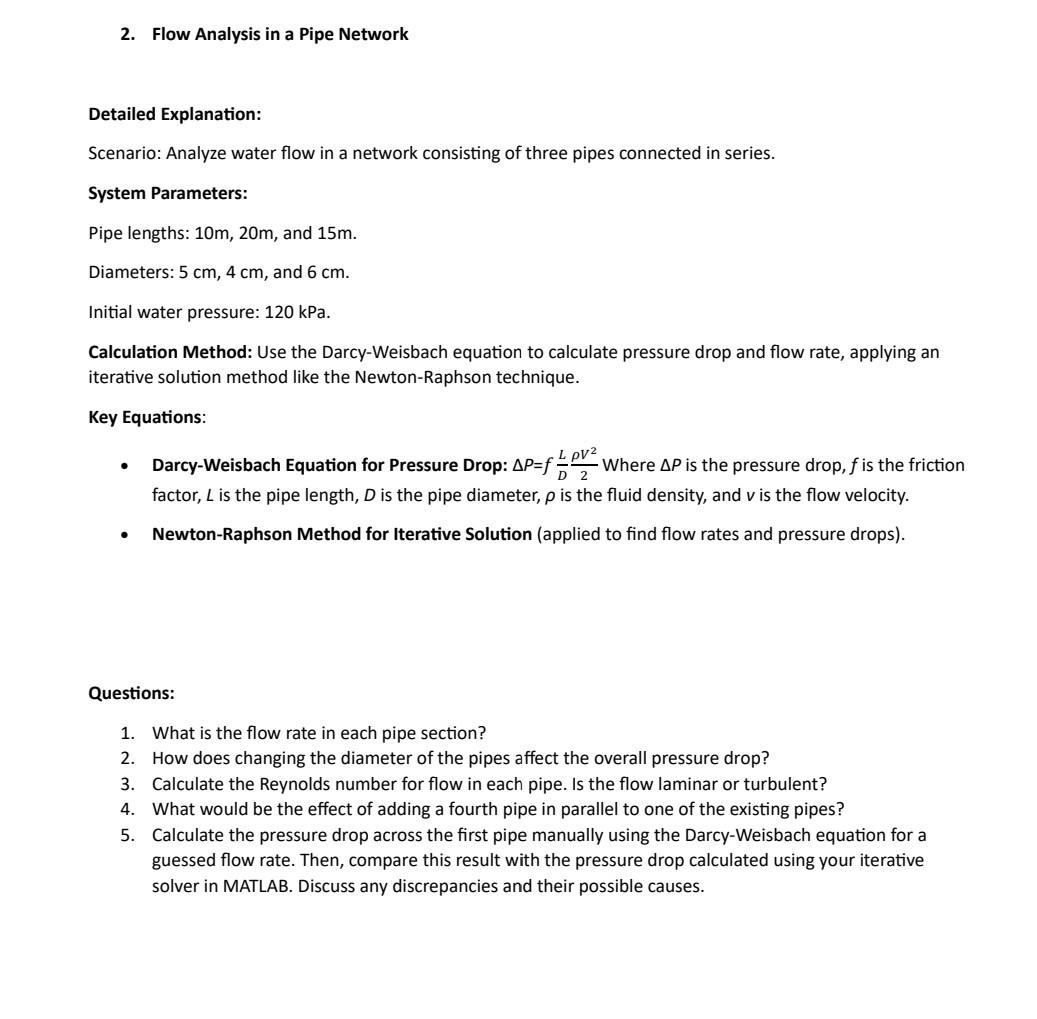
I want solve qoustion 5
2. Flow Analysis in a Pipe Network Detailed Explanation: Scenario: Analyze water flow in a network consisting of three pipes connected in series. System Parameters: Pipe lengths: , and . Diameters: , and . Initial water pressure: . Calculation Method: Use the Darcy-Weisbach equation to calculate pressure drop and flow rate, applying an iterative solution method like the Newton-Raphson technique. Key Equations: - Darcy-Weisbach Equation for Pressure Drop: Where is the pressure drop, is the friction factor, is the pipe length, is the pipe diameter, is the fluid density, and is the flow velocity. - Newton-Raphson Method for Iterative Solution (applied to find flow rates and pressure drops). Questions: 1. What is the flow rate in each pipe section? 2. How does changing the diameter of the pipes affect the overall pressure drop? 3. Calculate the Reynolds number for flow in each pipe. Is the flow laminar or turbulent? 4. What would be the effect of adding a fourth pipe in parallel to one of the existing pipes? 5. Calculate the pressure drop across the first pipe manually using the Darcy-Weisbach equation for a guessed flow rate. Then, compare this result with the pressure drop calculated using your iterative solver in MATLAB. Discuss any discrepancies and their possible causes.