Home /
Expert Answers /
Operations Management /
lecture-11-project-planning-11a-what-is-a-work-breakdown-structure-why-do-we-need-it-provide-a-mi-pa121
(Solved): Lecture 11 Project planning 11a What is a work breakdown structure? Why do we need it? Provide a mi ...
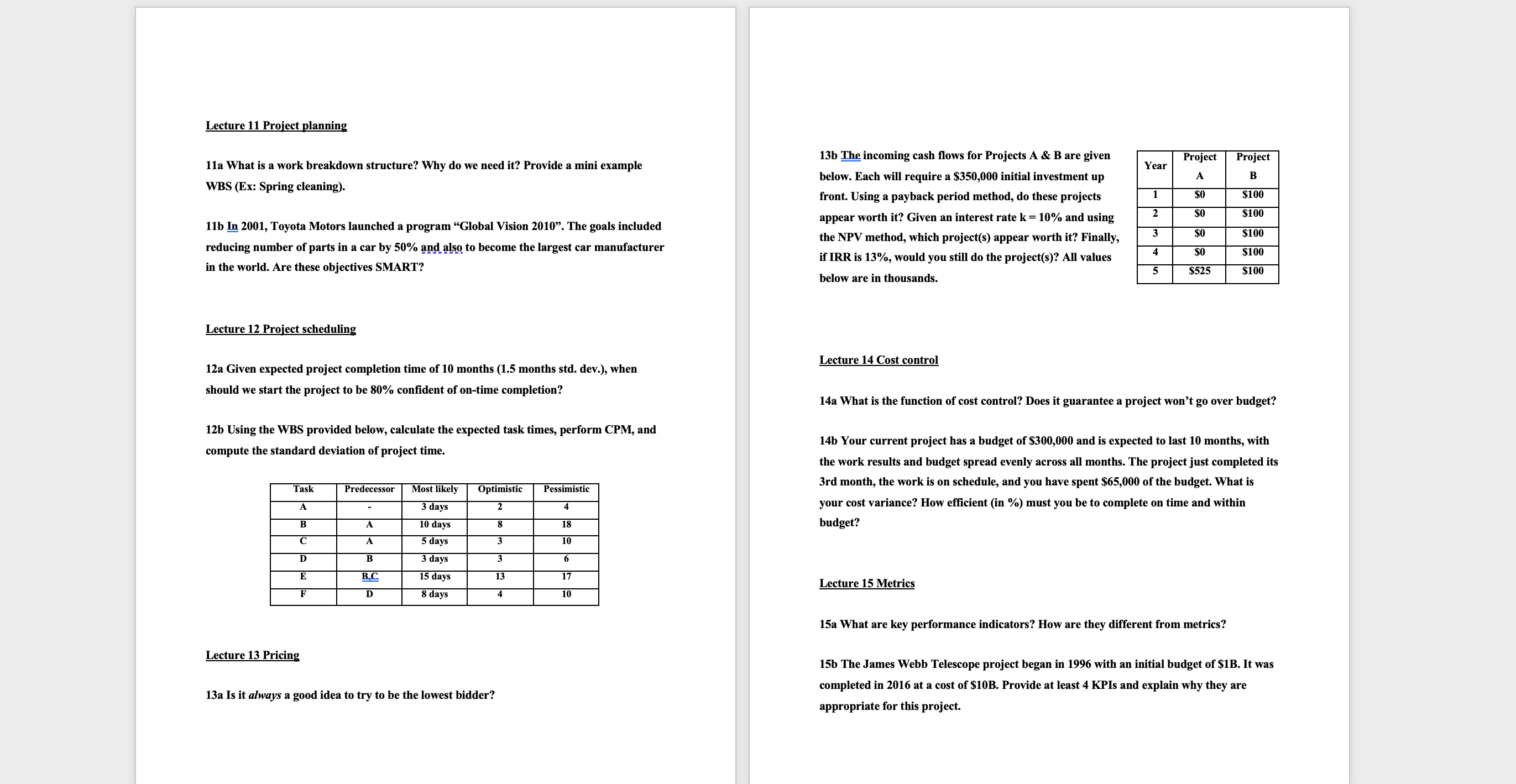
Lecture 11 Project planning 11a What is a work breakdown structure? Why do we need it? Provide a mini example WBS (Ex: Spring cleaning). 11b In 2001, Toyota Motors launched a program "Global Vision 2010". The goals included reducing number of parts in a car by and also to become the largest car manufacturer in the world. Are these objectives SMART? Lecture 12 Project scheduling 12a Given expected project completion time of 10 months (1.5 months std. dev.), when should we start the project to be confident of on-time completion? 12b Using the WBS provided below, calculate the expected task times, perform CPM, and compute the standard deviation of project time. 13b The incoming cash flows for Projects A \& B are given below. Each will require a initial investment up front. Using a payback period method, do these projects appear worth it? Given an interest rate and using the NPV method, which project(s) appear worth it? Finally, if IRR is , would you still do the project(s)? All values below are in thousands. Lecture 14 Cost control 14a What is the function of cost control? Does it guarantee a project won't go over budget? 14b Your current project has a budget of and is expected to last 10 months, with the work results and budget spread evenly across all months. The project just completed its 3rd month, the work is on schedule, and you have spent of the budget. What is your cost variance? How efficient (in \%) must you be to complete on time and within budget? Lecture 15 Metrics 15a What are key performance indicators? How are they different from metrics? 15b The James Webb Telescope project began in 1996 with an initial budget of \$1B. It was completed in 2016 at a cost of \$10B. Provide at least 4 KPIs and explain why they are appropriate for this project. Lecture 13 Pricing 13a Is it always a good idea to try to be the lowest bidder?