(Solved): OFDM System Design Consider an OFDM system with N=256 subcarriers over a bandwidth of B=5MHz. Let th ...
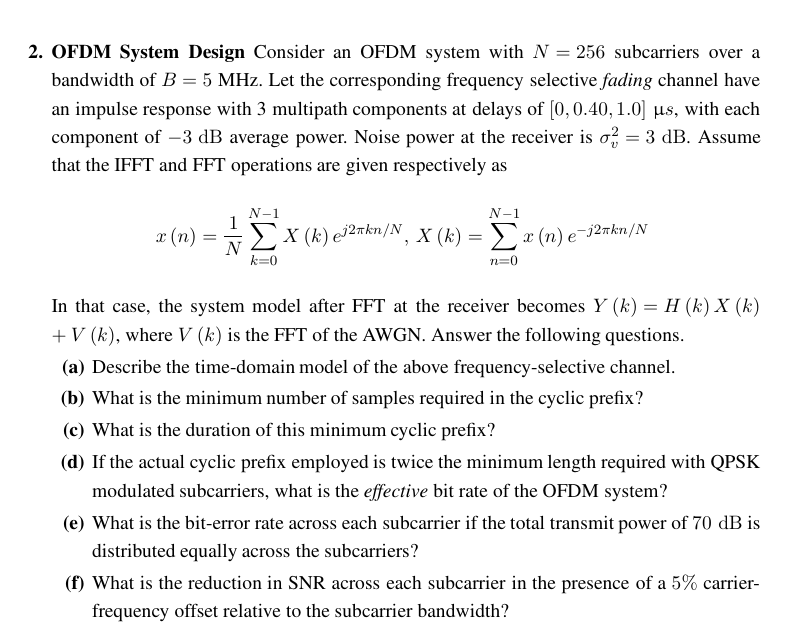
OFDM System Design Consider an OFDM system with N=256 subcarriers over a bandwidth of B=5MHz. Let the corresponding frequency selective fading channel have an impulse response with 3 multipath components at delays of [0,0.40,1.0]\mu s, with each component of -3 dB average power. Noise power at the receiver is \sigma _(v)^(2)=3dB. Assume that the IFFT and FFT operations are given respectively as x(n)=(1)/(N)\sum_(k=0)^(N-1) x(k)e^(j2\pi k(n)/(N)),x(k)=\sum_(n=0)^(N-1) x(n)e^(-j2\pi k(n)/(N)) In that case, the system model after FFT at the receiver becomes Y(k)=H(k)x(k) +V(k), where V(k) is the FFT of the AWGN. Answer the following questions. (a) Describe the time-domain model of the above frequency-selective channel. (b) What is the minimum number of samples required in the cyclic prefix? (c) What is the duration of this minimum cyclic prefix? (d) If the actual cyclic prefix employed is twice the minimum length required with QPSK modulated subcarriers, what is the effective bit rate of the OFDM system? (e) What is the bit-error rate across each subcarrier if the total transmit power of 70 dB is distributed equally across the subcarriers? (f) What is the reduction in SNR across each subcarrier in the presence of a 5% carrier- frequency offset relative to the subcarrier bandwidth?