(Solved): Problem 2. Plot on log-log coordinates estimated S-N curves for (a) bending, (b) axial, and (c) tors ...
Problem 2. Plot on log-log coordinates estimated S-N curves for (a) bending, (b) axial, and (c) torsional loading of a 1-in.-diameter steel bar having
S_(u)=110ksi,S_(y)=77ksi, and machined surfaces. For each of the three types of loading, what is the fatigusf strength corresponding to (1)
10^(6)or more cycles, and (2)
6\times 10^(4)cycles? Tip: Find the fatigue strength for the case of fully reversed load fluctuations meaning the mean stress is zero and the minimum and maximum stresses have the same absolute value and opposite signs. For each loading mode (bending, axial, torsion) use table 8.1 to find the endurance limit and the fatigue strength at 1000 cycles. For axial loading use a
C_(G)of 0.8 . Plot the
S-Ncurves. Use proportional triangles rule (or line equation) to find the fatigue strengths at
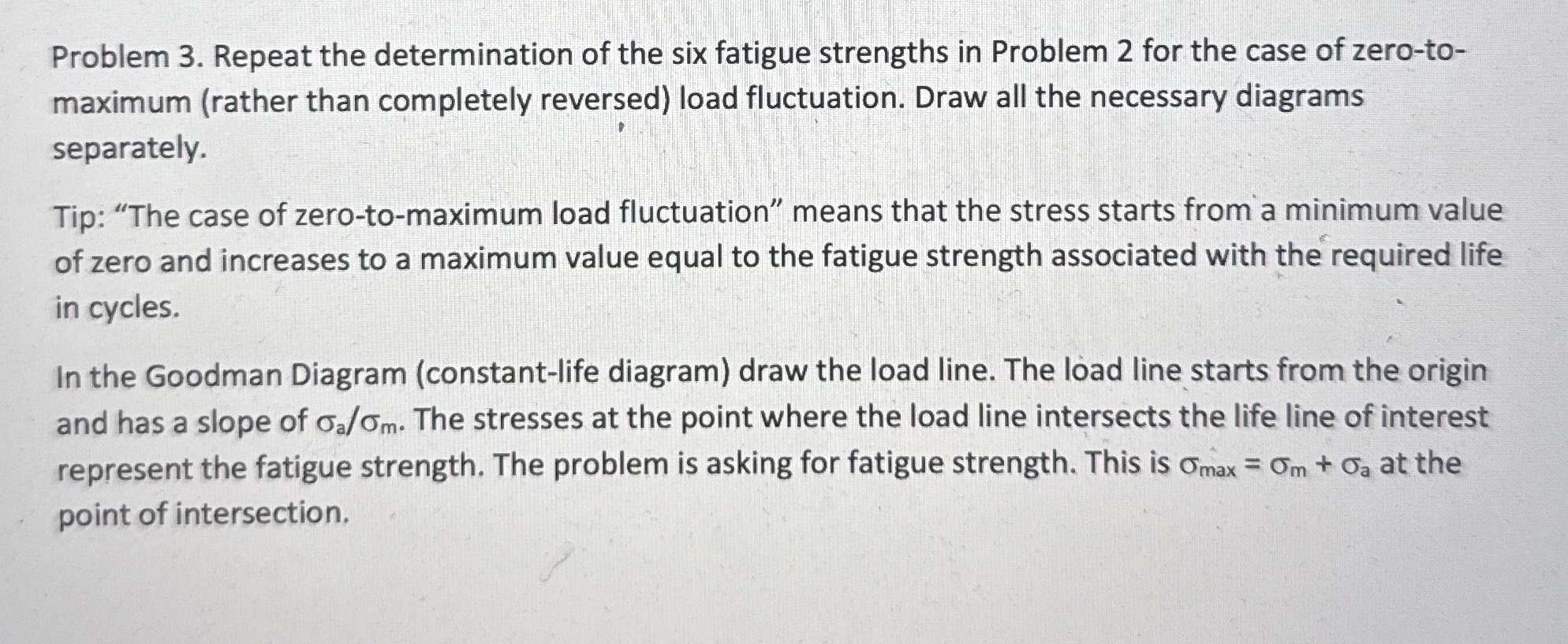
6\times 10^(4)cyclesof life. Make sure you take into account the log-log scale.Problem 3. Repeat the determination of the six fatigue strengths in Problem 2 for the case of zero-tomaximum (rather than completely reversed) load fluctuation. Draw all the necessary diagrams separately. Tip: "The case of zero-to-maximum load fluctuation" means that the stress starts from a minimum value of zero and increases to a maximum value equal to the fatigue strength associated with the required life in cycles. In the Goodman Diagram (constant-life diagram) draw the load line. The load line starts from the origin and has a slope of
(\sigma _(a))/(\sigma _(m)). The stresses at the point where the load line intersects the life line of interest represent the fatigue strength. The problem is asking for fatigue strength. This is
\sigma _(max)=\sigma _(m) \sigma _(a)at the point of intersection. USE PROBLEM 2 TO SOLVE PROBLEM 3