(Solved): PROBLEM STATEMENT An experimental nuclear core simulation apparatus is a specialized system ...
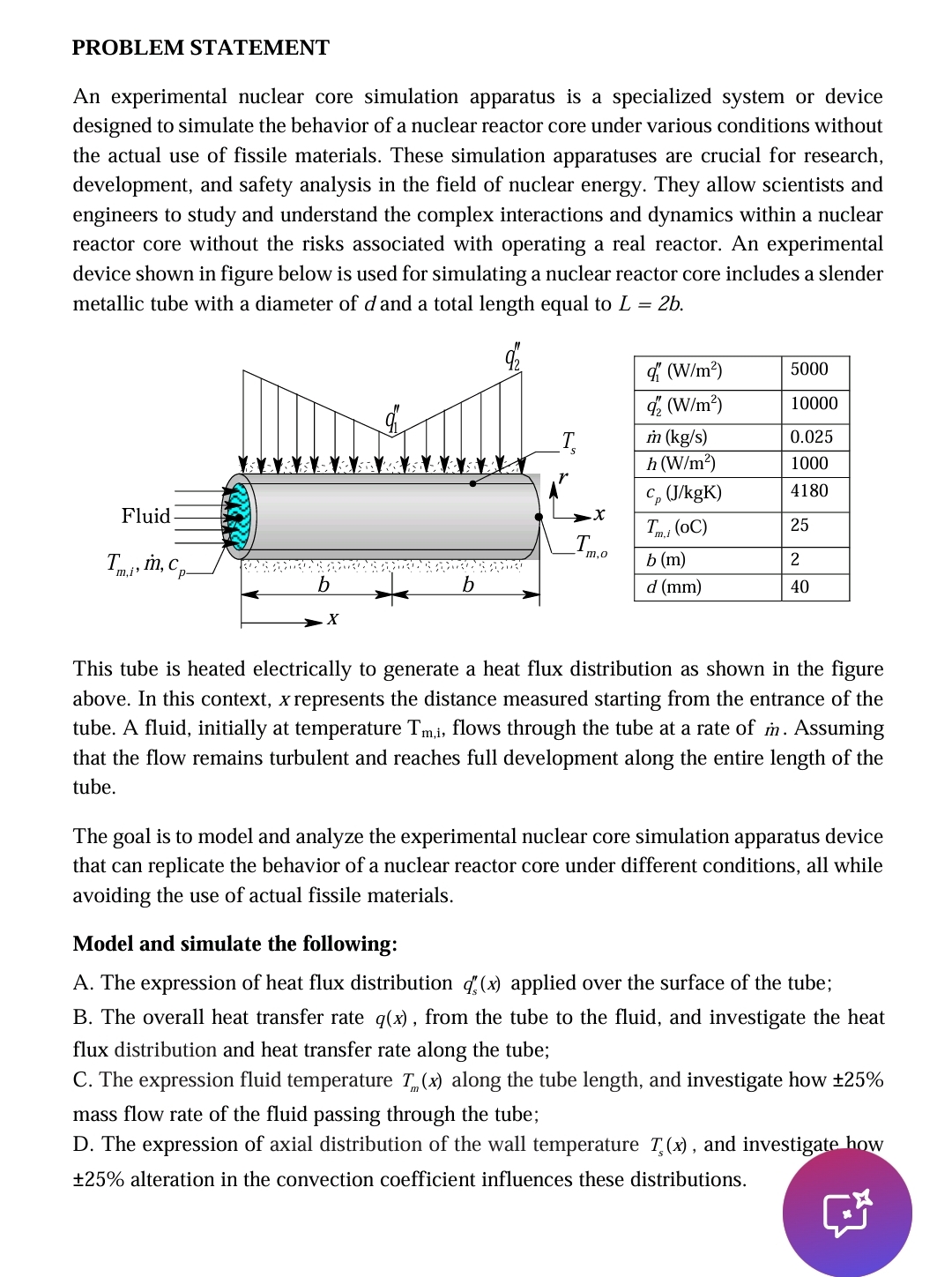
PROBLEM STATEMENT An experimental nuclear core simulation apparatus is a specialized system or device designed to simulate the behavior of a nuclear reactor core under various conditions without the actual use of fissile materials. These simulation apparatuses are crucial for research, development, and safety analysis in the field of nuclear energy. They allow scientists and engineers to study and understand the complex interactions and dynamics within a nuclear reactor core without the risks associated with operating a real reactor. An experimental device shown in figure below is used for simulating a nuclear reactor core includes a slender metallic tube with a diameter of
dand a total length equal to
L=2b. \table[[
q_(1)^('')((W)/(m^(2))),5000],[
q_(2)^('')((W)/(m^(2))),10000],[
m^(?)(k(g)/(s)),0.025],[
h((W)/(m^(2))),1000],[
c_(p)((J)/(k)gK),4180],[
T_(m,i)(oC),25],[
b(m),2],[
d(mm),40]] This tube is heated electrically to generate a heat flux distribution as shown in the figure above. In this context,
xrepresents the distance measured starting from the entrance of the tube. A fluid, initially at temperature
T_(m,i), flows through the tube at a rate of
m^(?). Assuming that the flow remains turbulent and reaches full development along the entire length of the tube. The goal is to model and analyze the experimental nuclear core simulation apparatus device that can replicate the behavior of a nuclear reactor core under different conditions, all while avoiding the use of actual fissile materials. Model and simulate the following: A. The expression of heat flux distribution
q_(s)^('')(x)applied over the surface of the tube; B. The overall heat transfer rate
q(x), from the tube to the fluid, and investigate the heat flux distribution and heat transfer rate along the tube; C. The expression fluid temperature
T_(m)(x)along the tube length, and investigate how
+-25%mass flow rate of the fluid passing through the tube; D. The expression of axial distribution of the wall temperature
T_(s)(x), and investigate how
+-25%alteration in the convection coefficient influences these distributions.