Home /
Expert Answers /
Advanced Math /
question-4-only-thank-you-1-suppose-that-vec-x-inr-n-and-vec-x-gt-0-suppose-that-vec-a-v-pa621
(Solved): Question 4 only. Thank you! (1) Suppose that vec(x)inR^(n) and vec(x)>=0. Suppose that vec(a),v ...
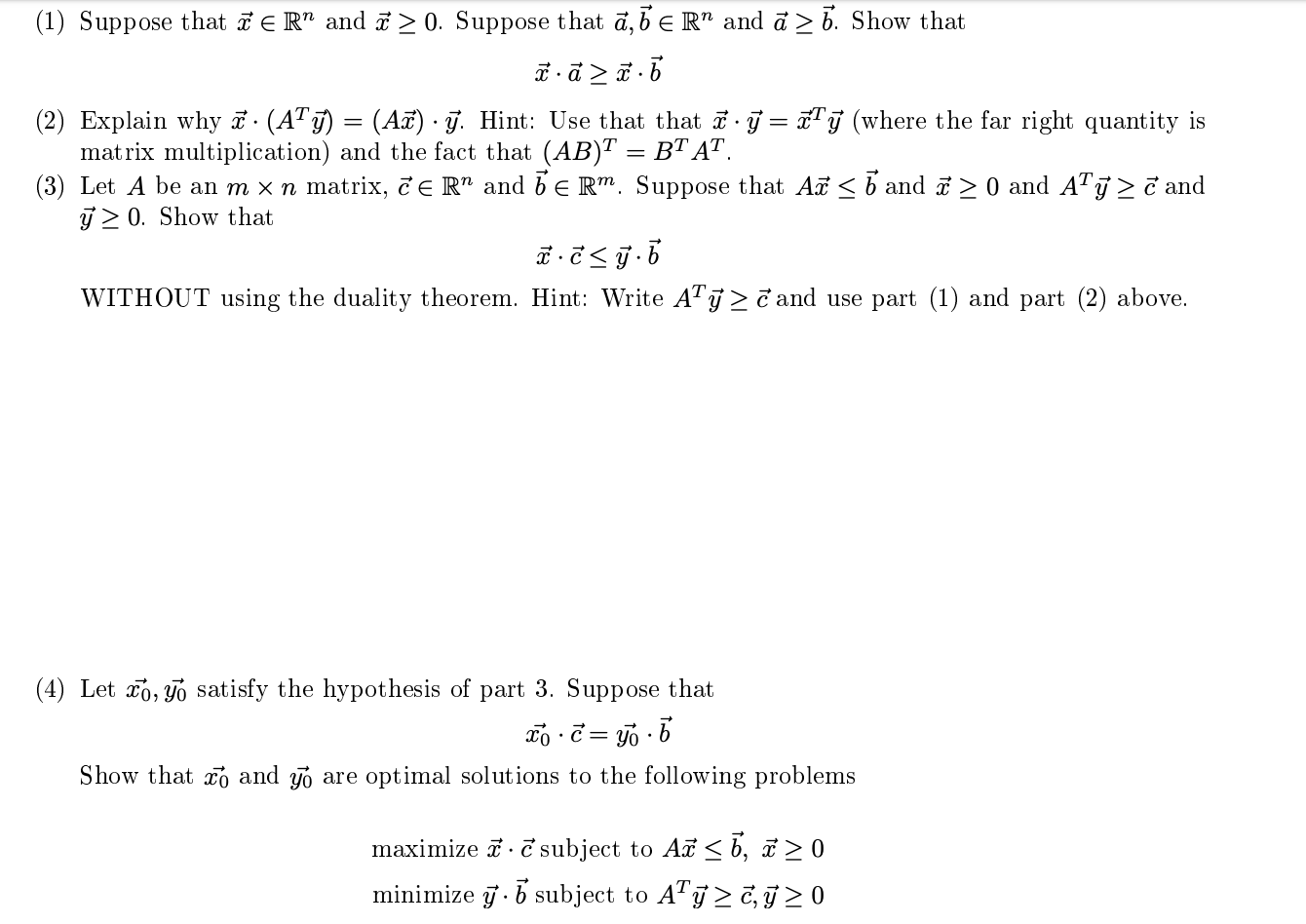
Question 4 only. Thank you! (1) Suppose that
vec(x)inR^(n)and
vec(x)>=0. Suppose that
vec(a),vec(b)inR^(n)and
vec(a)>=vec(b). Show that
vec(x)*vec(a)>=vec(x)*vec(b)(2) Explain why
vec(x)*(A^(T)(vec(y)))=(Avec(x))*vec(y). Hint: Use that that
vec(x)*vec(y)=vec(x)^(T)vec(y)(where the far right quantity is matrix multiplication) and the fact that
(AB)^(T)=B^(T)A^(T). (3) Let
Abe an
m\times nmatrix,
vec(c)inR^(n)and
vec(b)inR^(m). Suppose that
Avec(x)<=vec(b)and
vec(x)>=0and
A^(T)vec(y)>=vec(c)and
vec(y)>=0. Show that
vec(x)*vec(c)<=vec(y)*vec(b)WITHOUT using the duality theorem. Hint: Write
A^(T)vec(y)>=vec(c)and use part (1) and part (2) above. (4) Let
vec(x_(0)),vec(y_(0))satisfy the hypothesis of part 3 . Suppose that
vec(x_(0))*vec(c)=vec(y_(0))*vec(b)Show that
vec(x_(0))and
vec(y_(0))are optimal solutions to the following problems
 maximize vec(x)*vec(c) subject to Avec(x)<=vec(b),vec(x)>=0
 minimize vec(y)*vec(b) subject to A^(T)vec(y)>=vec(c),vec(y)>=0