(Solved): Ruestions 12000 Al Tutor (C) Hide ser question. ncorrect s late for a daily total score. sck on each ...
Ruestions 12000 Al Tutor (C) Hide ser question. ncorrect s late for a daily total score. sck on each al resources. Question 20 of 20 A geneticist discovers an obese mouse in their laboratory colony. They breed this obese mouse with a wild-type mouse. All the
F_(1)mice from this cross are wild-type in size. When the geneticist interbreeds two
F_(1)mice, eight of the
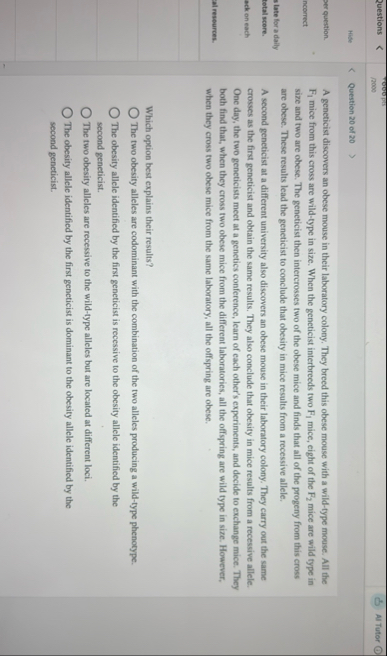
F_(2)mice are wild type in size and two are obese. The geneticist then intercrosses two of the obese mice and finds that all of the progeny from this cross are obese. These results lead the geneticist to conclude that obesity in mice results from a recessive allele. A second geneticist at a different university also discovers an obese mouse in their laboratory colony. They carry out the same crosses as the first geneticist and obtain the same results. They also conclude that obesity in mice results from a recessive allele. One day, the two geneticists meet at a genetics conference, learn of each other's experiments, and decide to exchange mice. They both find that, when they cross two obese mice from the different laboratories, all the offspring are wild type in size. However, when they cross two obese mice from the same laboratory, all the offspring are obese. Which option best explains their results?
?The two obesity alleles are codominant with the combination of the two alleles producing a wild-type phenotype.
?The obesity allele identified by the first geneticist is recessive to the obesity allele identified by the second geneticist.
?The two obesity alleles are recessive to the wild-type alleles but are located at different loci.
?The obesity allele identified by the first geneticist is dominant to the obesity allele identified by the second geneticist.