Home /
Expert Answers /
Economics /
solow-model-with-effective-labour-and-government-spending-consider-a-variant-of-the-solow-model-wh-pa435
(Solved): Solow model with effective labour and government spending Consider a variant of the Solow model, wh ...
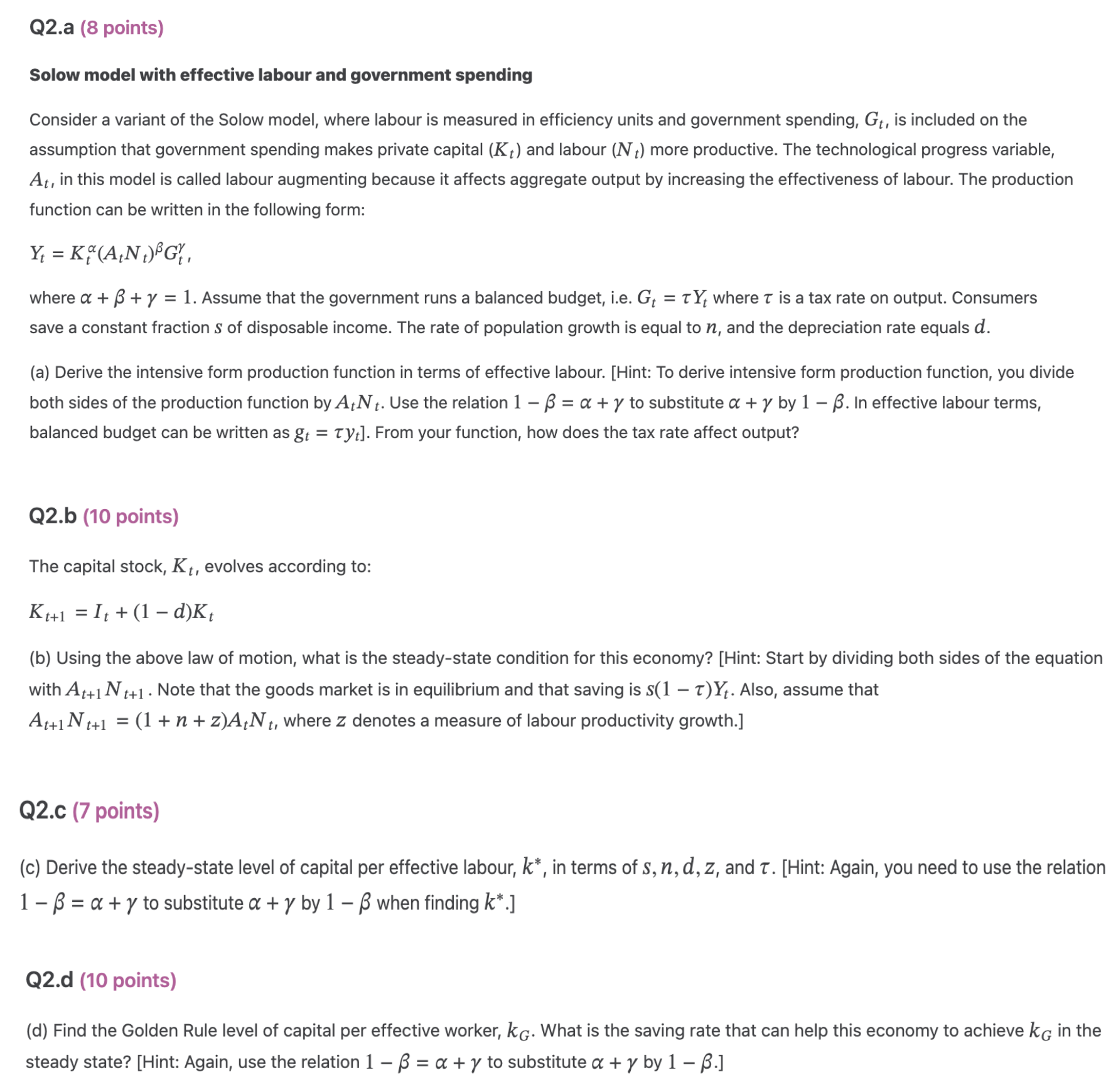
Solow model with effective labour and government spending Consider a variant of the Solow model, where labour is measured in efficiency units and government spending, , is included on the assumption that government spending makes private capital and labour more productive. The technological progress variable, , in this model is called labour augmenting because it affects aggregate output by increasing the effectiveness of labour. The production function can be written in the following form: where . Assume that the government runs a balanced budget, i.e. where is a tax rate on output. Consumers save a constant fraction of disposable income. The rate of population growth is equal to , and the depreciation rate equals . (a) Derive the intensive form production function in terms of effective labour. [Hint: To derive intensive form production function, you divide both sides of the production function by . Use the relation to substitute by . In effective labour terms, balanced budget can be written as . From your function, how does the tax rate affect output? Q2.b (10 points) The capital stock, , evolves according to: (b) Using the above law of motion, what is the steady-state condition for this economy? [Hint: Start by dividing both sides of the equation with . Note that the goods market is in equilibrium and that saving is . Also, assume that , where denotes a measure of labour productivity growth.] Q2.c (7 points) (c) Derive the steady-state level of capital per effective labour, , in terms of , and . [Hint: Again, you need to use the relation to substitute by when finding .] Q2.d (10 points) (d) Find the Golden Rule level of capital per effective worker, . What is the saving rate that can help this economy to achieve in the steady state? [Hint: Again, use the relation to substitute by .]