(Solved): The following GIF demonstrates how chromatin-remodeling complexes can slide nucleosomes along the DN ...
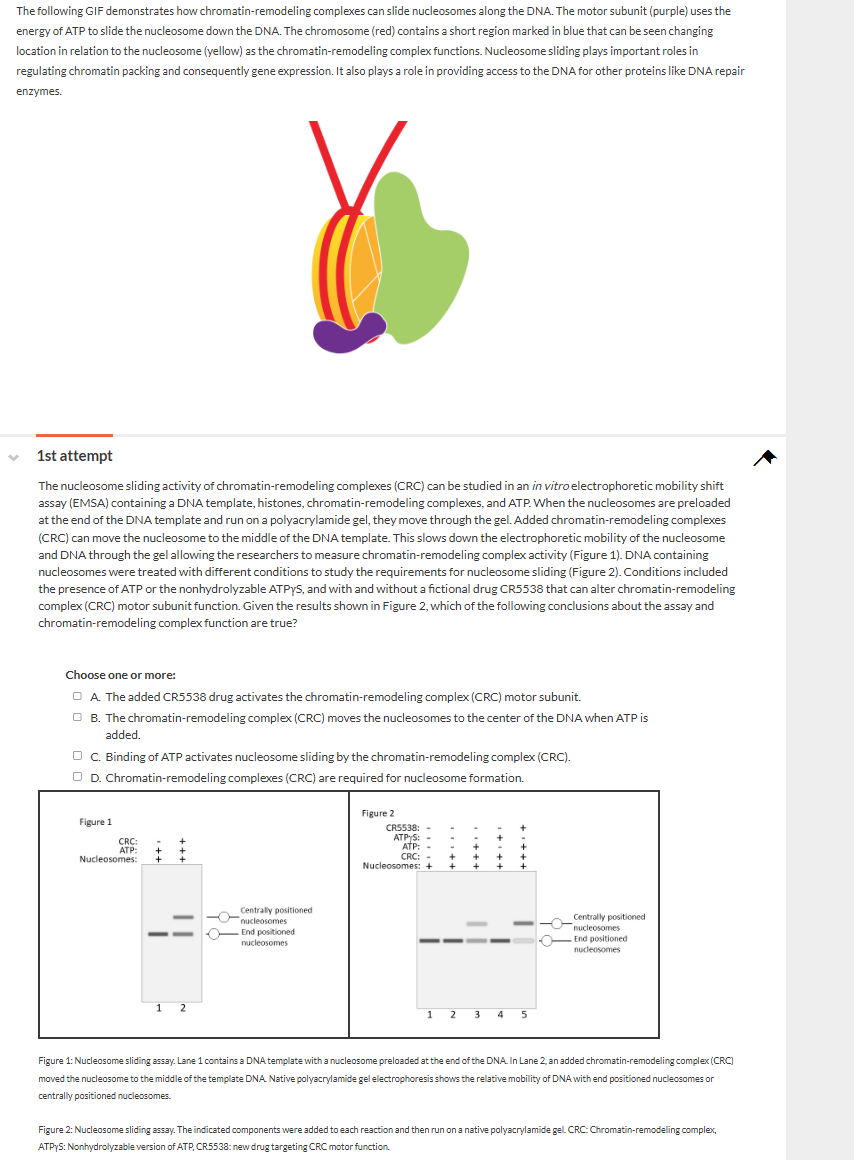
The following GIF demonstrates how chromatin-remodeling complexes can slide nucleosomes along the DNA. The motor subunit (purple) uses the energy of ATP to slide the nucleosome down the DNA. The chromosome (red) contains a short region marked in blue that can be seen changing location in relation to the nucleosome (yellow) as the chromatin-remodeling complex functions. Nucleosome sliding plays important roles in regulating chromatin packing and consequently gene expression. It also plays a role in providing access to the DNA for other proteins like DNA repair enzymes. 1st attempt The nucleosome sliding activity of chromatin-remodeling complexes (CRC) can be studied in an in vitro electrophoretic mobility shift assay (EMSA) containing a DNA template, histones, chromatin-remodeling complexes, and ATP. When the nucleosomes are preloaded at the end of the DNA template and run on a polyacrylamide gel, they move through the gel. Added chromatin-remodeling complexes (CRC) can move the nucleosome to the middle of the DNA template. This slows down the electrophoretic mobility of the nucleosome and DNA through the gel allowing the researchers to measure chromatin-remodeling complex activity (Figure 1). DNA containing nucleosomes were treated with different conditions to study the requirements for nucleosome sliding (Figure 2). Conditions included the presence of ATP or the nonhydrolyzable ATP \( \gamma \) S, and with and without a fictional drug CR5538 that can alter chromatin-remodeling complex (CRC) motor subunit function. Given the results shown in Figure 2, which of the following conclusions about the assay and chromatin-remodeling complex function are true? Choose one or more: \( \square \) A. The added CR5538 drug activates the chromatin-remodeling complex (CRC) motor subunit. B. The chromatin-remodeling complex (CRC) moves the nucleosomes to the center of the DNA when ATP is added. C. Binding of ATP activates nucleosome sliding by the chromatin-remodeling complex (CRC). D. Chromatin-remodeling complexes (CRC) are required for nucleosome formation. Figure 1 Figure 1: Nucleosome sliding assay. Lane 1 contains a DNA template with a nucleosome preloaded at the end of the DNA. In Lane 2, an added chromatin-remodeling complex (CRC) moved the nucleosome to the middle of the template DNA. Native polyacrylamide gel electrophoresis shows the relative mobility of DNA with end positioned nucleosomes or centrally positioned nucleosomes. Figure 2: Nucleosome sliding assay. The indicated components were added to each reaction and then run on a native polyacrylamide gel. CRC: Chromatin-remodeling complex, ATP YS: Nonhydrolyzable version of ATP, CR5538: new drug targeting CRC motor function.