Home /
Expert Answers /
Advanced Physics /
the-nonlinear-equation-of-motion-for-our-damped-pendulum-has-the-form-d-2-theta-dt-2-q-d-t-pa905
(Solved): The nonlinear equation of motion for our damped pendulum has the form: (d^(2)\theta )/(dt^(2))+q(d\t ...
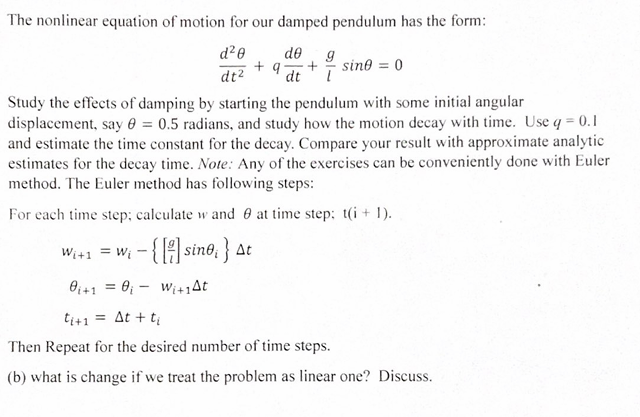
The nonlinear equation of motion for our damped pendulum has the form:
(d^(2)\theta )/(dt^(2))+q(d\theta )/(dt)+(g)/(l)sin\theta =0
Study the effects of damping by starting the pendulum with some initial angular
displacement, say \theta =0.5 radians, and study how the motion decay with time. Use q=0.1
and estimate the time constant for the decay. Compare your result with approximate analytic
estimates for the decay time. Note: Any of the exercises can be conveniently done with Euler
method. The Euler method has following steps:
For each time step; calculate w and \theta  at time step; t(i+1).
w_(i+1)=w_(i)-{[(g)/(l)]sin\theta _(i)}\Delta t
\theta _(i+1)=\theta _(i)-w_(i+1)\Delta t
t_(i+1)=\Delta t+t_(i)
Then Repeat for the desired number of time steps.
(b) what is change if we treat the problem as linear one? Discuss. PLEASE SO BY HAND . EXPLAIN STEPS AS WELL