Home /
Expert Answers /
Advanced Math /
the-quantum-calculus-conundrum-consider-a-non-hermitian-operator-a-acting-on-a-normalized-pa158
(Solved): The Quantum Calculus Conundrum: Consider a non-Hermitian operator A^ acting on a normalized ...
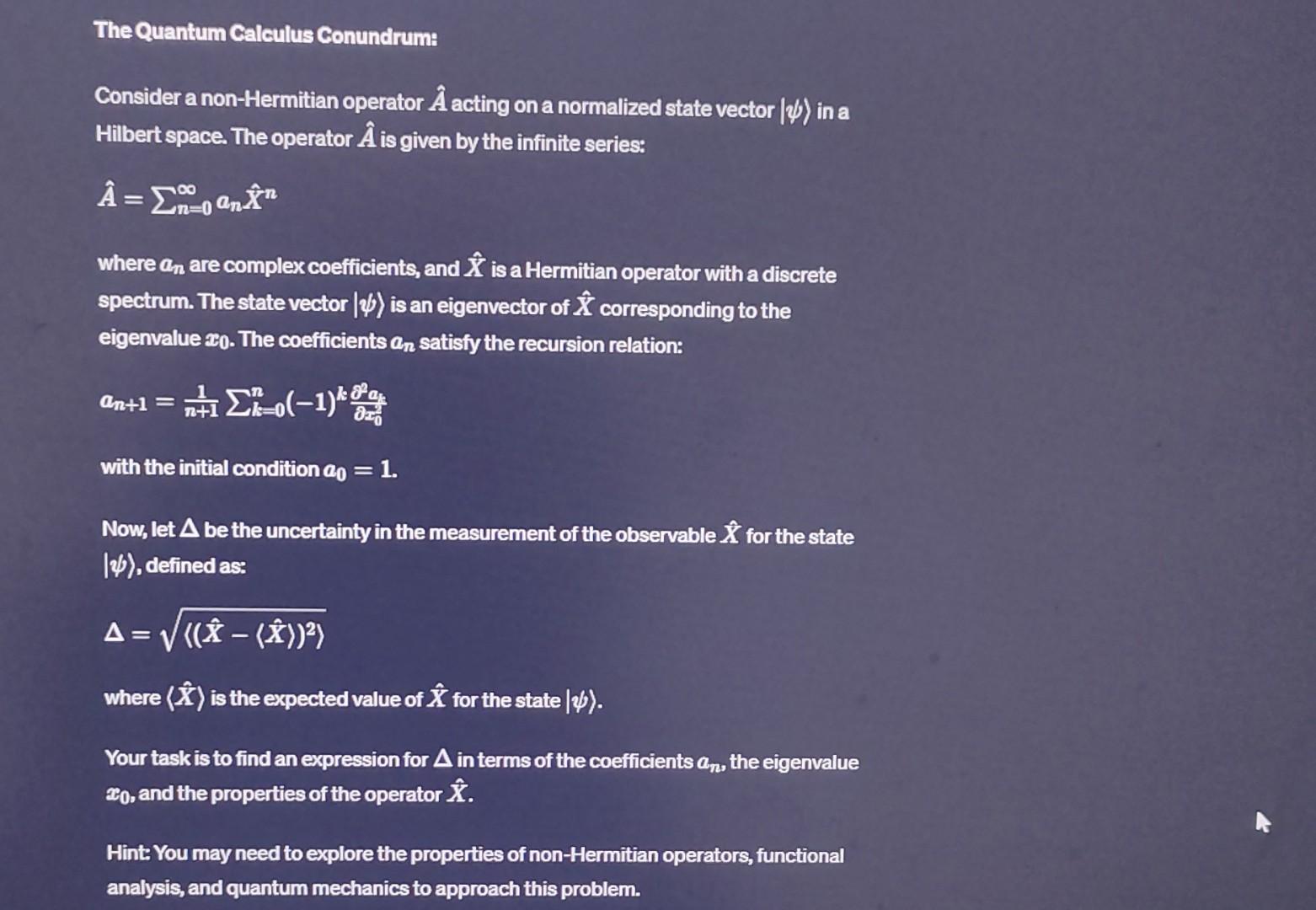
The Quantum Calculus Conundrum: Consider a non-Hermitian operator acting on a normalized state vector in a Hilbert space. The operator is given by the infinite series: where are complex coefficients, and is a Hermitian operator with a discrete spectrum. The state vector is an eigenvector of corresponding to the eigenvalue . The coefficients satisfy the recursion relation: with the initial condition . Now, let be the uncertainty in the measurement of the observable for the state , defined as: where is the expected value of for the state . Your task is to find an expression for in terms of the coefficients , the eigenvalue , and the properties of the operator . Hint: You may need to explore the properties of non-Hermitian operators, functional analysis, and quantum mechanics to approach this problem.
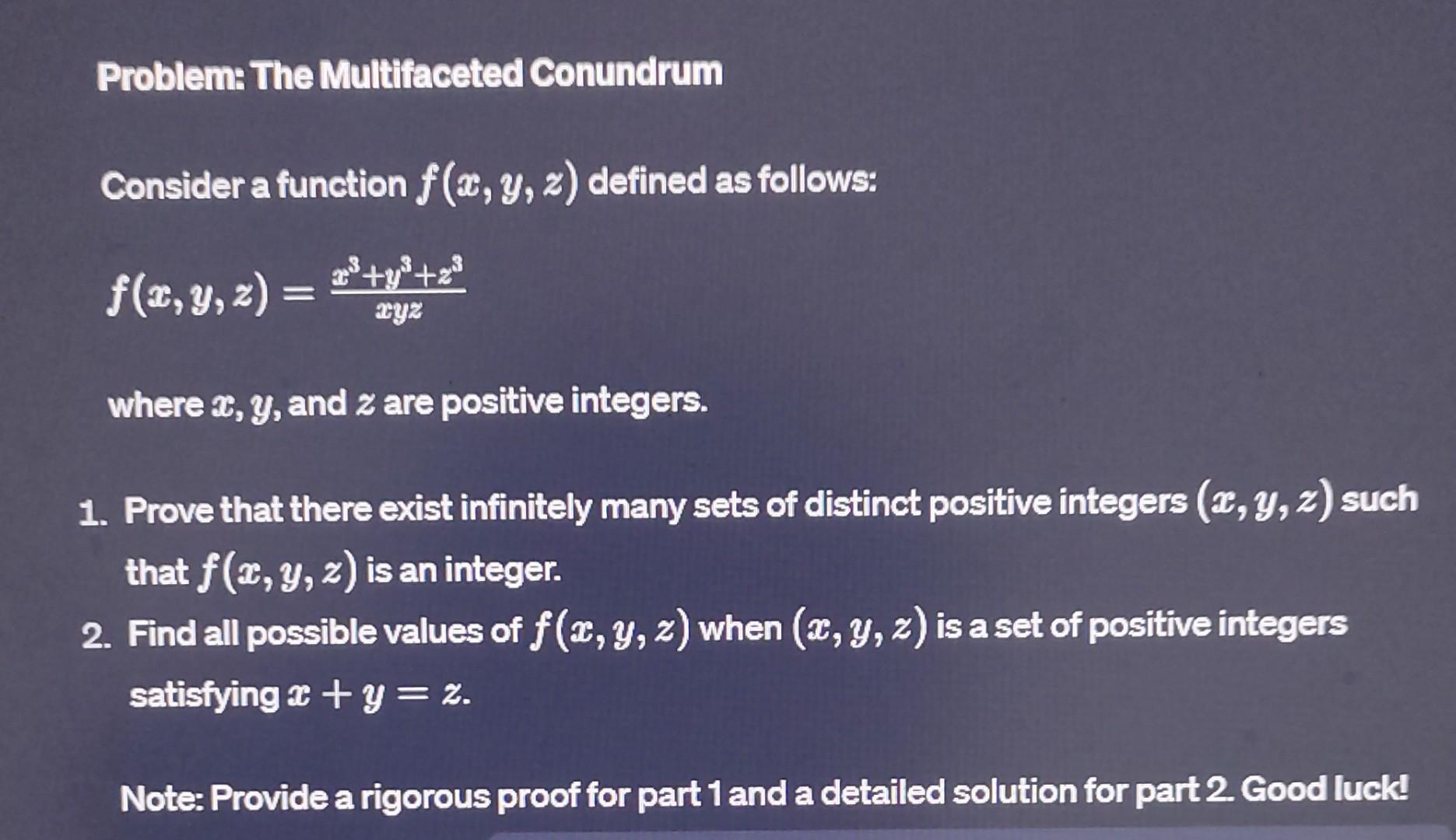
Problem: The Multifaceted Conundrum Consider a function defined as follows: where , and are positive integers. 1. Prove that there exist infinitely many sets of distinct positive integers such that is an integer. 2. Find all possible values of when is a set of positive integers satisfying . Note: Provide a rigorous proof for part 1 and a detailed solution for part 2 . Good luck!