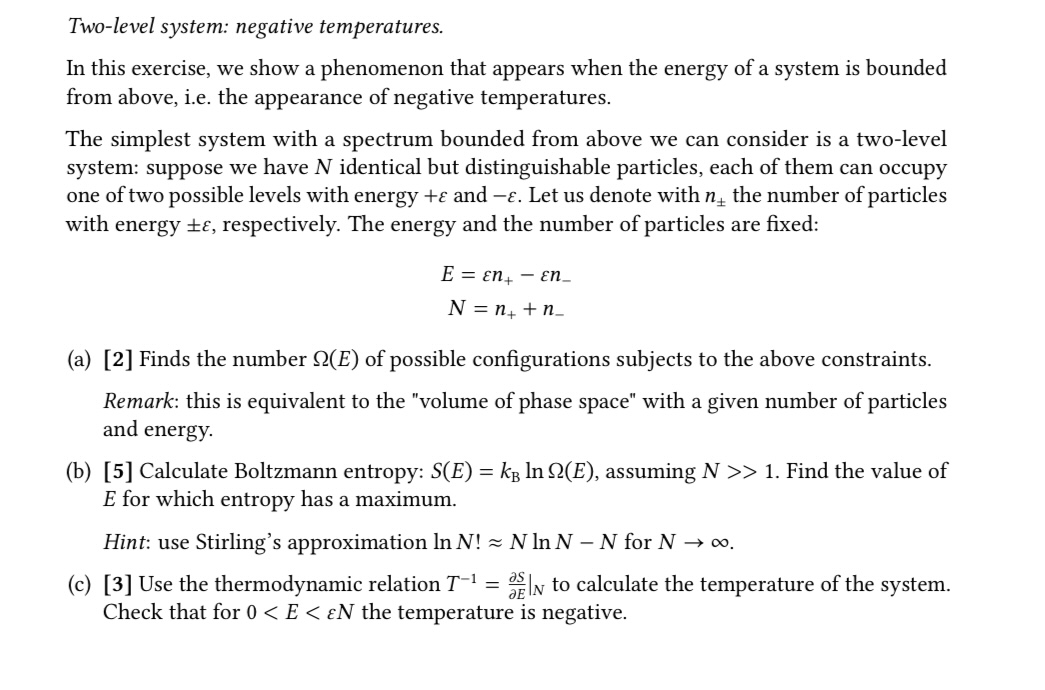
(Solved): Two-level system: negative temperatures. In this exercise, we show a phenomenon that appears when ...
Two-level system: negative temperatures. In this exercise, we show a phenomenon that appears when the energy of a system is bounded from above, i.e. the appearance of negative temperatures. The simplest system with a spectrum bounded from above we can consider is a two-level system: suppose we have
Nidentical but distinguishable particles, each of them can occupy one of two possible levels with energy
+\epsi and
-\epsi . Let us denote with
n_(+-)the number of particles with energy
+-\epsi , respectively. The energy and the number of particles are fixed:
E=\epsi n_(+)-\epsi n_(-)
N=n_(+)+n_(-)
(a) [2] Finds the number
\Omega (E)of possible configurations subjects to the above constraints. Remark: this is equivalent to the "volume of phase space" with a given number of particles and energy. (b) [5] Calculate Boltzmann entropy:
S(E)=k_(B)ln\Omega (E), assuming
N>>1. Find the value of
Efor which entropy has a maximum. Hint: use Stirling's approximation
lnN!~~NlnN-Nfor
N->\infty . (c) [3] Use the thermodynamic relation
T^(-1)= /frac{/diffp{S}}{/diffp{E}}|_(N)to calculate the temperature of the system. Check that for
0 the temperature is negative.