Home /
Expert Answers /
Advanced Math /
what-does-this-mean-n-nn-2-1-36-n1-10-when-one-knows-the-true-values-x-1-and-x-2-and-has-pa885
(Solved): What does this mean...\\n\\nn_(2)=1.36\\n1-10 When one knows the true values x_(1) and x_(2) and has ...
What does this mean...\\n\\n
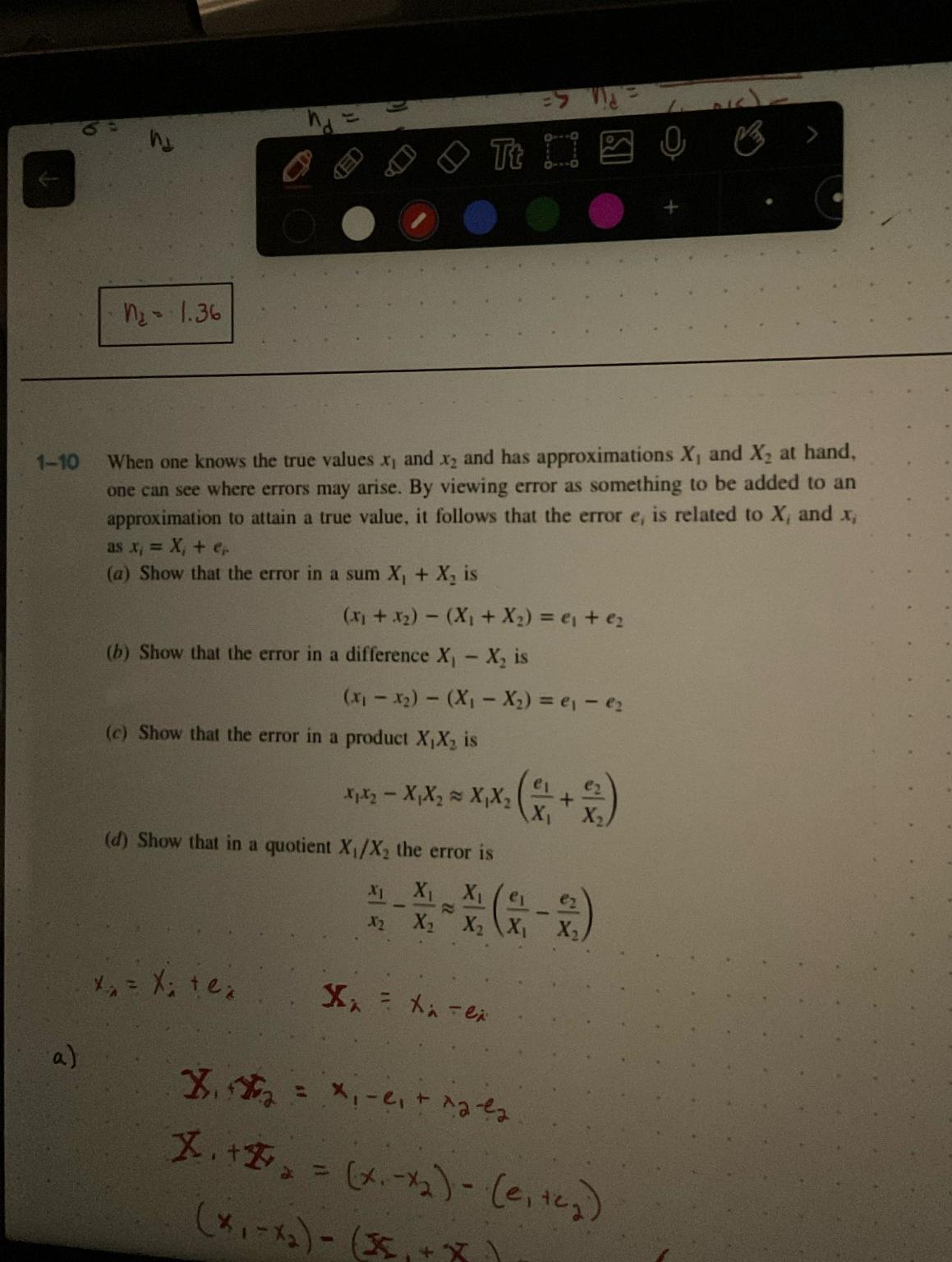
n_(2)=1.36\\n1-10 When one knows the true values
x_(1)and
x_(2)and has approximations
x_(1)and
x_(2)at hand, one can see where errors may arise. By viewing error as something to be added to an approximation to attain a true value, it follows that the error
e_(i)is related to
x_(i)and
x_(i)as
x_(i)=x_(i)+e_(i)\\n(a) Show that the error in a sum
x_(1)+x_(2)is\\n
(x_(1)+x_(2))-(x_(1)+x_(2))=e_(1)+e_(2)\\n(b) Show that the error in a difference
x_(1)-x_(2)is\\n
(x_(1)-x_(2))-(x_(1)-x_(2))=e_(1)-e_(2)\\n(c) Show that the error in a product
x_(1)x_(2)is\\n
x_(1)x_(2)-x_(1)x_(2)~~x_(1)x_(2)((e_(1))/(x_(1))+(e_(2))/(x_(2)))\\n(d) Show that in a quotient
(x_(1))/(x_(2))the error is\\n
(x_(1))/(x_(2))-(x_(1))/(x_(2))~~(x_(1))/(x_(2))((e_(1))/(x_(1))-(e_(2))/(x_(2)))\\n
x_(i)=x_(i)+e_(i),x_(i)=x_(i)-e_(i)\\na)\\n
x_(1)+Z_(2)=x_(1)-e_(1)+x_(2)-e_(2)\\nxx_(1)+Z_(2)=(x_(1)-x_(2))-(e_(1)+c_(2))\\n(x_(1)-x_(2))-(xx_(1)+x)