Home /
Expert Answers /
Other /
write-conclusion-only-11-2-using-appropriate-data-and-or-graphs-and-showing-any-calculations-and-app
(Solved): write Conclusion only 11.2 Using appropriate data and/or graphs and showing any calculations and app ...
write Conclusion only
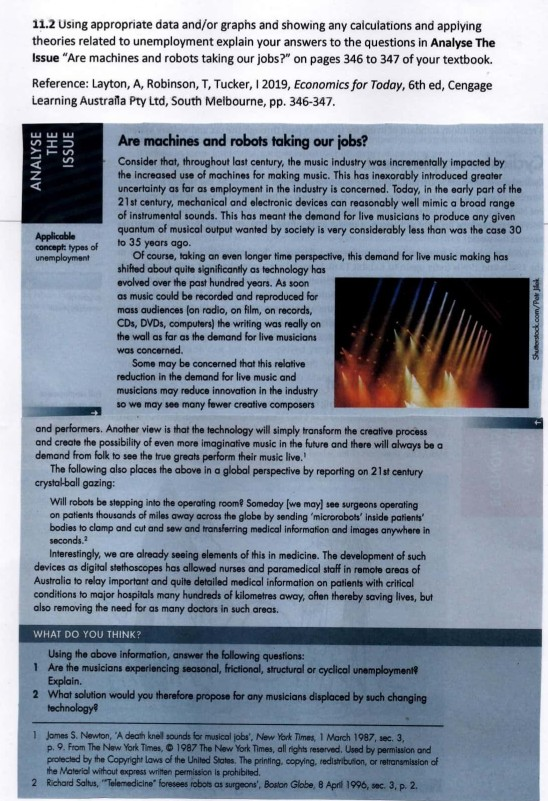
11.2 Using appropriate data and/or graphs and showing any calculations and applying theories related to unemployment explain your answers to the questions in Analyse The Issue "Are machines and robots taking our jobs?" on pages 346 to 347 of your textbook. Reference: Layton, A, Robinson, T, Tucker, I 2019, Economics for Today, 6th ed, Cengage Learning Austraita Pty Ltd, South Melbourne, pp. 346-347. THE ANALYSE ISSUE Shutterstock.com/Polok Are machines and robots taking our jobs? Consider that, throughout last century, the music industry was incrementally impacted by the increased use of machines for making music. This has inexorably introduced greater uncertainty as far as employment in the industry is concerned. Today, in the early part of the 21st century, mechanical and electronic devices can reasonably well mimic a broad range of instrumental sounds. This has meant the demand for live musicians to produce any given quantum of musical output wanted by society is very considerably less than was the case 30 Applicable concept types of to 35 years ago unemployment Of course, taking an even longer time perspective, this demand for live music making has shifted about quite significantly as technology has evolved over the past hundred years. As soon as music could be recorded and reproduced for mass audiences (on radio, on film, on records, CDs, DVDs, computers) the writing was really on the wall as far as the demand for live musicians was concerned. Some may be concerned that this relative reduction in the demand for live music and musicians may reduce innovation in the industry so we may see many fewer creative composers and performers. Another view is that the technology will simply transform the creative process and create the possibility of even more imaginative music in the future and there will always be a demand from folk to see the true greats perform their music live. The following also places the above in a global perspective by reporting on 21st century crystal-ball gazing: Will robot be stepping into the operating room Someday [we may see surgeons operating on patients thousands of miles away across the globe by sending 'microrobots' inside patients' bodies to clamp and cut and sew and transferring medical information and images anywhere in seconds. Interestingly, we are already seeing elements of this in medicine. The development of such devices as digital stethoscopes has allowed nurses and paramedical staff in remote areas of Australia to relay important and quite detailed medical information on patients with critical conditions to major hospitals many hundreds of kilometres away, often thereby saving lives, but also removing the need for as many doctors in such areas. WHAT DO YOU THINK? Using the above information, answer the following questions: 1 Are the musicians experiencing seasonal, frictional, structural or cyclical unemployment Explain. 2 What solution would you therefore propose for any musicians displaced by such changing technology 1 James S. Newton, 'A death knel sounds for musical jobs', New York Times, 1 March 1987, sec. 3, p. 9. From The New York Times, © 1987 The New York Times, all rights reserved. Used by permission and protected by the Copyright laws of the United States. The printing, copying, redistribution, or retransmission of the Material without express written permission is prohibited. 2 Richard Saltus, "Telemedicine foresees robots as surgeons', Boston Globe, 8 April 1996, c. 3. p. 2.
Expert Answer
Answer to 11.2 Using appropriate data and/or graphs and showing any calculations and applying theories related to unemployment exp...