1)Would the subsidiaries still be competitive and adaptive inlocal markets if forced to coordinate with other subsidiariesaround the world? Why?
2) Would Business Managers be able to change the habits ofsubsidiary managers toward more global behaviors? Why?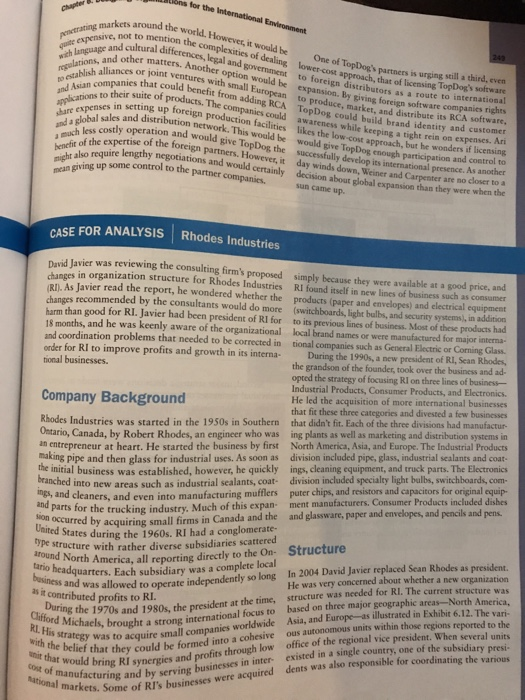
Chapter for the International Environment applications to foreign distributors as a route to international to produce, market, and distribute its RCA software, awareness while keeping a tight rein on expenses. Ari sun came up Rhodes Industries with language and cultural differences, legal and government quite expensive, not to mention the complexities of dealing lower-cost approach, that of licensing TopDog's software porting markets around the world. However, it would be regulations, and other matters. Another option would be expansion. By giving foreign software companies rights One of TopDog's partners is urging still a third, even and Asian companies that could benefit from adding RCA TopDog could build brand identity and customer to establish alliances or joint ventures with small European to their suite of products. The companies could share expenses in setting up foreign production facilities likes the low-cost approach, but he wonders if licensing and a global sales and distribution network. This would be would give TopDog enough participation and control to benefit of the expertise of the foreign partners. However, it day winds down, Weiner and Carpenter are no closer to a much less costly operation and would give TopDog, the successfully develop its international presence. As another might also require lengthy negotiations and would certainly decision about global expansion than they were when the mean giving up some control to the partner companies. United States during the 1960s. RI had a conglomerate- type structure with rather diverse subsidiaries scattered around North America, all reporting directly to the On- Structure tario headquarters. Each subsidiary was a complete local business and was allowed to operate independently so long In 2004 David Javier replaced Sean Rhodes as president. During the 1970s and 1980s, the president at the time, RI. His strategy was to acquire small companies worldwide Asia, and Europe as illustrated in Exhibit 6.12. The vari- Clifford Michaels, brought a strong international focus to with the belief that they could be formed into a cohesive unit that would bring RI synergies and profits through low office of the regional vice president. When several units Cost of manufacturing and by serving businesses in inter National markets. Some of Ri's businesses were acquired dents was also responsible for coordinating the various 249 CASE FOR ANALYSIS Duvid Javier was reviewing the consulting firm's proposed simply because they were available at a good price, and changes in organization structure for Rhodes Industries RI found itself in new lines of business such as consumer RI). As Javier read the report, he wondered whether the products (paper and envelopes) and electrical equipment changes recommended by the consultants would do more (switchboards, light bulbs, and security systems), in addition harm than good for RI. Javier had been president of Rl for to its previous lines of business. Most of these products had 18 months, and he was keenly aware of the organizational local brand names or were manufactured for major interna and coordination problems that needed to be corrected in order for RI to improve profits and growth in its interna- tional companies such as General Electric or Corning Glass tional businesses. During the 1990s, a new president of RI, Sean Rhodes, the grandson of the founder, took over the business and ad- opted the strategy of focusing Rl on three lines of business- Industrial Products, Consumer Products, and Electronics. Company Background He led the acquisition of more international businesses that fit these three categories and divested a few businesses Rhodes Industries was started in the 1950s in Southern that didn't fit. Each of the three divisions had manufactur- Ontario, Canada, by Robert Rhodes, an engineer who was ing plants as well as marketing and distribution systems in an entrepreneur at heart. He started the business by first North America, Asia, and Europe. The Industrial Products making pipe and then glass for industrial uses. As soon as division included pipe, glass, industrial sealants and coat- the initial business was established, however, he quickly ings, cleaning equipment, and truck parts. The Electronics branched into new areas such as industrial sealants, coat division included specialty light bulbs, switchboards.com ings, and cleaners, and even into manufacturing mufflers puter chips, and resistors and capacitors for original equip tion occurred by acquiring small firms in Canada and the and glassware, paper and envelopes, and pencils and pens. He was very concerned about whether a new organization as it contributed profits to RI. structure was needed for RI. The current structure was based on three major geographic areas-North America, ous autonomous units within those regions reported to the existed in a single country, one of the subsidiary presi-