Expert Answers

(Solved): 2. Business Environment Analysis Report (BEAR)In the BEAR, s...

2. Business Environment Analysis Report (BEAR)
In the BEAR, students will analyze the business environment inthe market. Students should remember that this is about developinga market in the selected country, not going there to have fun asatourist. Therefore, your work should not include data which isnot directly relevant to the goal of deciding whether the marketshould be developed or not. Data that would be relevant couldinclude, but may not necessarily be limited to, the followingitems:• Political and regulatory stability – Students will need todescribe and discuss the political and regulatory system withreference to their stability and receptivity to internationalbusiness, including foreign investment.• Legal system – Students will need to describe and discussthe kind of legal system that exists there. The following questionsare typically important in such a discussion - Is the legal systemtransparent and independent? Is it fair and objective? Does itprotect intellectual property, foreign investments, etc.?
• Business customs and practice – Students will need todescribe and discuss the business customs and practices that existthere. The following questions are typically important in such adiscussion - What role do ethics, corruption, and respect of lawplay? How are environmental concerns and human rights issuesaddressed?• Religion and culture – Students will need to describe anddiscuss the cultures that play a significant role in the country,specifically how these cultures might impact internationalbusiness.• Economic analysis of key indicators –o Demographicso GNP/GDPo Major sectors and industrieso Currency, interest, and inflationrateso International Trade patternso Labour
I selected Singapore for this.

(Solved): 2. Based on available information, a student develops a dec...

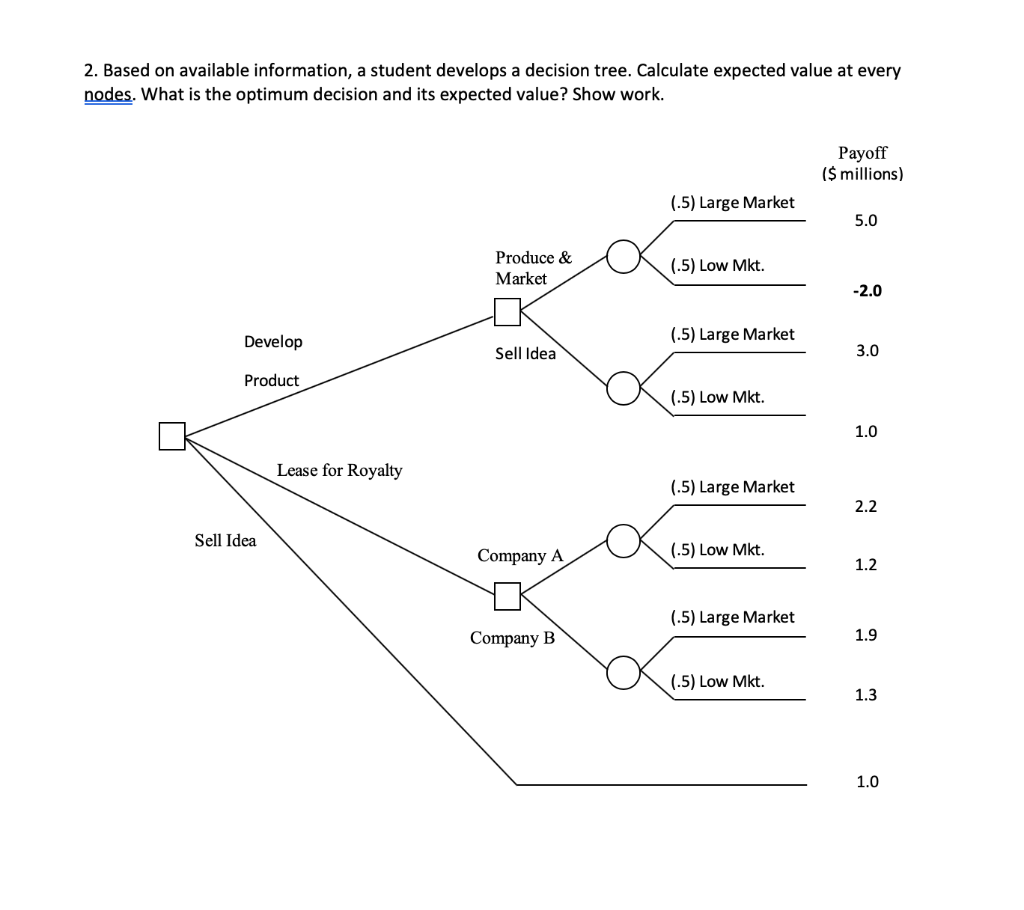
2. Based on available information, a student develops a decision tree. Calculate expected value at every nodes. What is the o

2. Based on available information, a student develops a decision tree. Calculate expected value at every nodes. What is the optimum decision and its expected value? Show work. Payoff ($ millions) (.5) Large Market 5.0 Produce & Market (.5) Low Mkt. -2.0 Develop (.5) Large Market Sell Idea 3.0 Product (.5) Low Mkt. 1.0 Lease for Royalty (.5) Large Market 2.2 Sell Idea Company A (.5) Low Mkt. 1.2 (.5) Large Market Company B 1.9 (.5) Low Mkt. 1.3 1.0

(Solved): 2. Calculate single factor productivity for each of the thr...


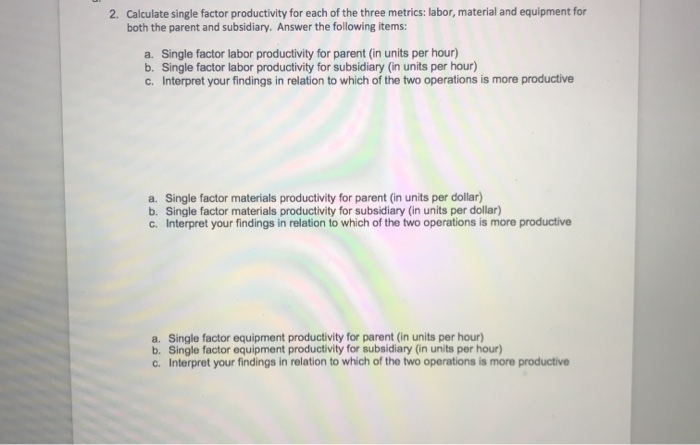
2. Calculate single factor productivity for each of the three metrics: labor, material and equipment for both the parent and
2. Calculate single factor productivity for each of the three metrics: labor, material and equipment for both the parent and subsidiary. Answer the following items: a. Single factor labor productivity for parent (in units per hour) b. Single factor labor productivity for subsidiary (in units per hour) c. Interpret your findings in relation to which of the two operations is more productive a. Single factor materials productivity for parent (in units per dollar) b. Single factor materials productivity for subsidiary (in units per dollar) c. Interpret your findings in relation to which of the two operations is more productive a. Single factor equipment productivity for parent (in units per hour) b. Single factor equipment productivity for subsidiary (in units per hour) c. Interpret your findings in relation to which of the two operations is more productive

(Solved): 2. [Ch. 1 Calculation of Productivity] Student tuition at A...


2. [Ch. 1 Calculation of Productivity] Student tuition at Anniston University is $1200 per semester credit hours. The states
2. [Ch. 1 Calculation of Productivity] Student tuition at Anniston University is $1200 per semester credit hours. The states supplement school revenue by matching student tuition, dollars per dollars. Average class size for typical three credit courses is 50 students. Labor costs are $5000 per class, material costs are $50 per student, and overhead cost are $40,000 per class. (a) What is the multifactor productivity ratio? Hint.(The output will be the tuition revenues.) (b) (Update) We assume the output (=tuition revenues) will remain the same from part (a), if instructors work an average, what is the labor productivity ratio? (Keep in mind that professor delivering the lecture work 40 hours per week the semester last for 15 weeks)

(Solved): 2- In which case in Module 2 is the vagueness doctrinediscus...

2- In which case in Module 2 is the vagueness doctrinediscussed?

Group of answer choices:

a)Lujan v. Defenders of Wildlife

b)Big Cat Rescue, Inc. v. Big Cat Rescue Entertainment

c)Wilkerson v. Florida

d)Yates v. United States

e)This is a trick question, as the vagueness doctrine was notdiscussed in any of the cases in Module 2.

4-Among other things, Module 2 contains the InternationalConvention for the Regulation of Whaling. This historicinternational treaty created the International Whaling Commission(IWC) in 1946, a global body that is supposed to promote theconservation of whales. When did the United States join theIWC?

Group of answer choices

a)1980 (President Jimmy Carter's last full year in office).

b)1973 (the year the Endangered Species Act was enacted by theCongress).

c)This is a trick question, as the United States has refused tojoin the IWC.

d)1948 (two years after the IWC was created).

e)1946 (the same year the IWC was created).

5-Among other things, Module 2 contains a State statute thatmakes it a crime to commit animal cruelty in the State of Florida.In what case in Module 2 was the constitutionality of this Floridalaw brought into question?

Group of answer choices

a)This is a trick, as the constitutionality of this law has notyet been challenged in court.

b)Wilkerson v. Florida

c)Yates v. US

d)State v. Jackson

e)Lujan v. Defenders of Wildlife

7-In which video does the Professor mention that he had thegreat honor of meeting Associate Justice Ruth BaderGinsburg (RBG)?

Group of answer choices

a)Video 2.3 on State Law

b)Video 2.4 on Federal Law

c)Video 2.9 on Legal Interpretation

d)This is a trick question, as the Professor has never had thehonor of meeting RBG in person.

e)Video 2.7 on International Law
(Solved): 2.What changes in the firm and/or in the environment might c...

2.What changes in the firm and/or in the environment might cause afirm to abandon the functional approach?3.How can systems that are built for global knowledge transfer beused as control tools?4.Firms differ, often substantially, in their organizationalstructures even within the same industry. What accounts for thesedifferences in their approaches?

?

(Solved): 2. Chuck no Risk (CNC) has collected the following informat...

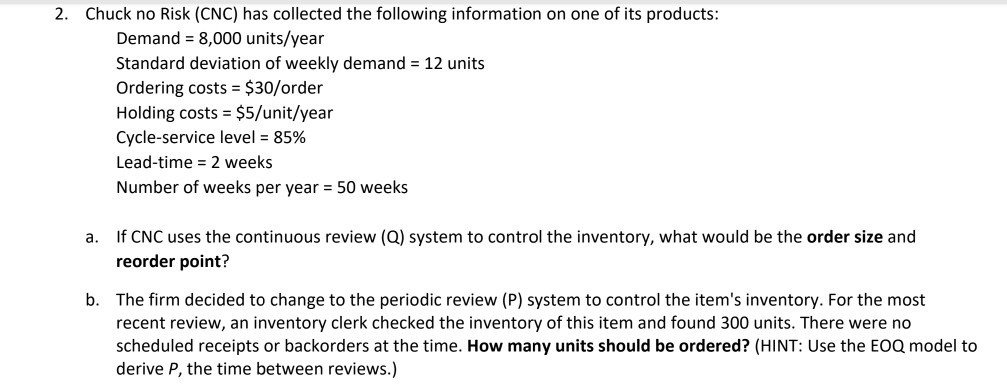
2. Chuck no Risk (CNC) has collected the following information on one of its products: Demand = 8,000 units/year Standard dev

2. Chuck no Risk (CNC) has collected the following information on one of its products: Demand = 8,000 units/year Standard deviation of weekly demand = 12 units Ordering costs = $30/order Holding costs = $5/unit/year Cycle-service level = 85% Lead-time = 2 weeks Number of weeks per year = 50 weeks a. If CNC uses the continuous review (Q) system to control the inventory, what would be the order size and reorder point? b. The firm decided to change to the periodic review (P) system to control the item's inventory. For the most recent review, an inventory clerk checked the inventory of this item and found 300 units. There were no scheduled receipts or backorders at the time. How many units should be ordered? (HINT: Use the EOQ model to derive P, the time between reviews.)

(Solved): 2. Cheap Retailers The following table shows financial data...

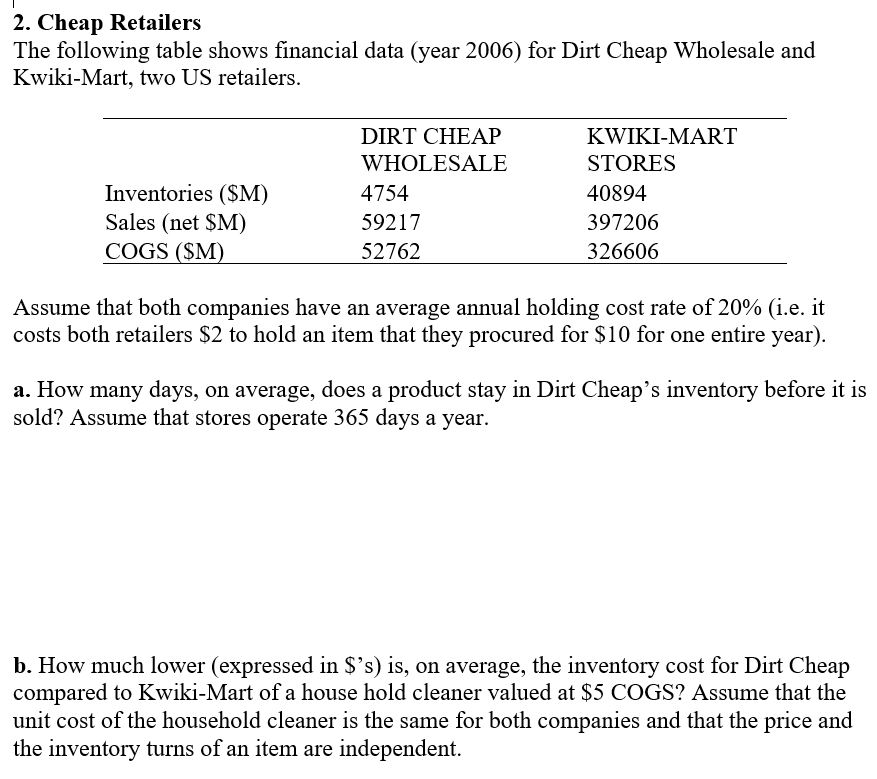
2. Cheap Retailers The following table shows financial data (year 2006) for Dirt Cheap Wholesale and Kwiki-Mart, two US retai

2. Cheap Retailers The following table shows financial data (year 2006) for Dirt Cheap Wholesale and Kwiki-Mart, two US retailers. Inventories (SM) Sales (net $M) COGS (SM) DIRT CHEAP WHOLESALE 4754 59217 52762 KWIKI-MART STORES 40894 397206 326606 Assume that both companies have an average annual holding cost rate of 20% (i.e.it costs both retailers $2 to hold an item that they procured for $10 for one entire year). a. How many days, on average, does a product stay in Dirt Cheap's inventory before it is sold? Assume that stores operate 365 days a year. b. How much lower (expressed in $'s) is, on average, the inventory cost for Dirt Cheap compared to Kwiki-Mart of a house hold cleaner valued at $5 COGS? Assume that the unit cost of the household cleaner is the same for both companies and that the price and the inventory turns of an item are independent.

(Solved): please answer ASAP,don't use software.thank you! 2. Cities m...

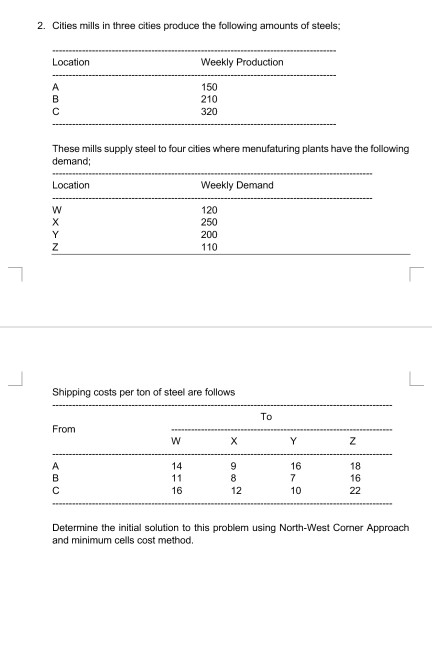
2. Cities mills in three cities produce the following amounts of steels; Location Weekly Production ? B ? 150 210 320 These m

please answer ASAP,don't use software.thank you!

2. Cities mills in three cities produce the following amounts of steels; Location Weekly Production ? B ? 150 210 320 These mills supply steel to four cities where menufaturing plants have the following demand Location Weekly Demand W ? Y Z 120 250 200 110 Shipping costs per ton of steel are follows ?? From w ? Y Z A B ? 14 11 16 9 8 12 16 7 10 18 16 22 Determine the initial solution to this problem using North-West Corner Approach and minimum cells cost method.

(Solved): 2. The most commonly seen layout of typical hospitals is: A...

2. The most commonly seen layout of typical hospitals is: A. Service layout B. Functional layout C. Repeat service layout D.

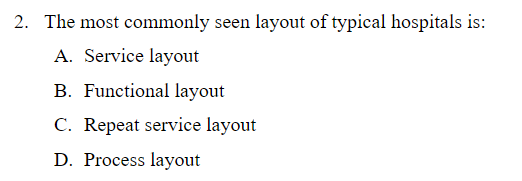
2. The most commonly seen layout of typical hospitals is: A. Service layout B. Functional layout C. Repeat service layout D. Process layout

We Provide Services Across The Globe